What was released
On 22 September, the vLLM project published version 0.30.0 of its open inference server. This is an update to the serving stack, not the release of a new base model. One addition is Fast Start: a separate process keeps prepared model weights in GPU memory so that, after an engine restart, they can be mapped through CUDA IPC instead of being loaded again from disk. The release also adds support for more model families and provides images for several platforms.
Practical implications
For a business already serving an internal RAG system or AI agents through vLLM, the key question is how long service recovery takes after an update or failure. Fast Start may reduce that particular downtime when restarts are frequent and the model is large. It does not automatically accelerate every request or make the GPU cheaper: retained weights occupy video memory, and the result depends on the actual hardware and configuration. For a small, single-GPU pilot with rare restarts, the benefit may not justify the added complexity.
Compatibility with the current installation also matters. According to the release notes, a plain `vllm serve` now exposes scale-out endpoints only when `--enable-scale-out` is set; this replaces the old `VLLM_ENABLE_SCALE_OUT_ENDPOINTS` environment variable. Some GPTQ and YaRN configurations are affected as well. That is a reason to check the configuration before upgrading, not to treat the release as a new model or a guaranteed throughput improvement.
Checks before deployment
- Record the current version, container image, model and launch parameters; rehearse the upgrade in a test environment first.
- Measure cold and repeat startup time, p95 latency and available GPU memory on representative requests. Published H200 improvements cannot simply be extrapolated to another card.
- Verify authentication, routing and scale-out endpoints after the flag changes; keep the previous image ready for rollback.
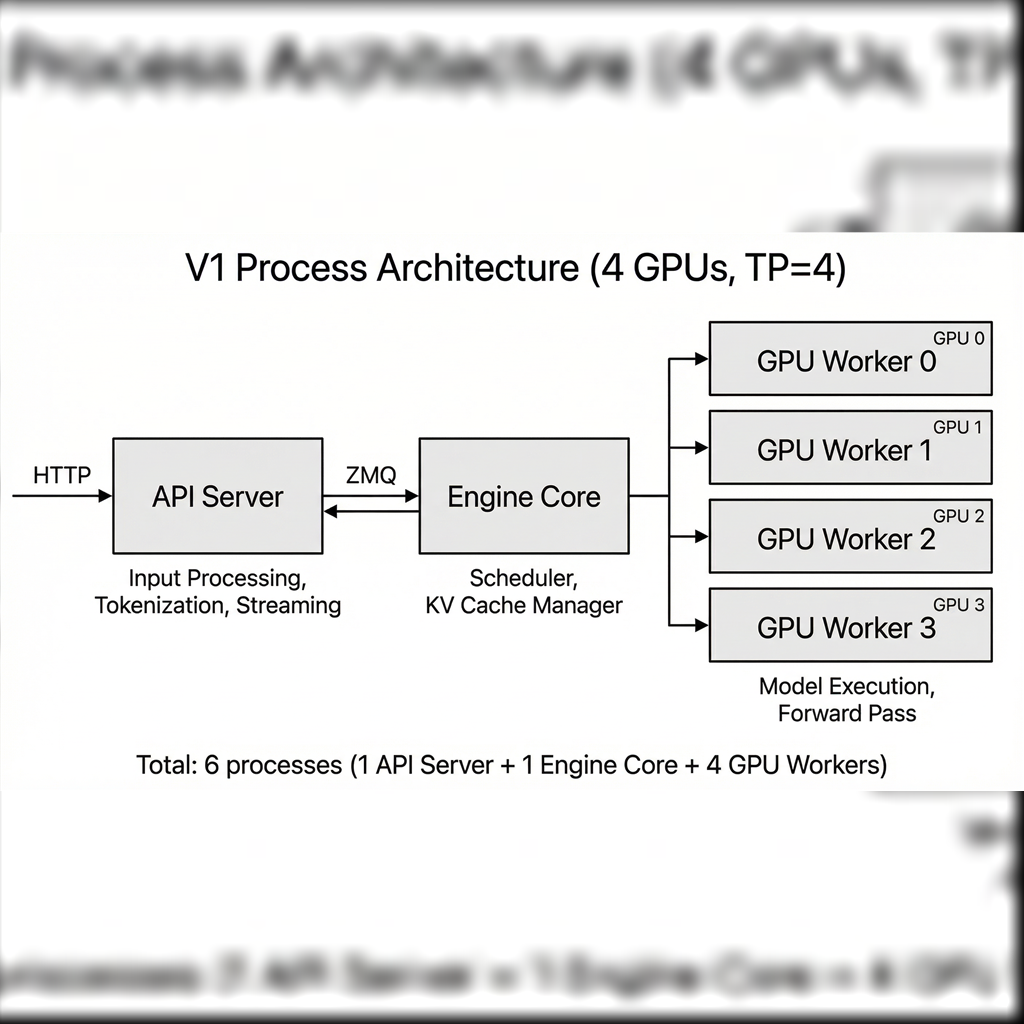
The official release provides CUDA 13.0 and 12.9, ROCm, CPU and XPU images. The appropriate build depends on the platform. The independent Local Model Watch overview corroborates the release date and highlights Fast Start, but it cannot replace measurements on your own server. The cover shows the official vLLM multi-process architecture, not the new Fast Start mechanism; the Apache-2.0 repository image was placed over a blurred continuation of the same original to make a square cover.