What happened
On 1 October 2026, LINAGORA released OpenRAG 2.3, a new version of its self-hosted document retrieval and answer generation system. The changes concern operations more than the quality of the language model itself: they make it easier to distinguish a healthy search service from one that is still answering while some documents have not been indexed.
What the release confirms
Each embedder now has its own vector field. Searches in a document partition use the embedder assigned to that partition, while safeguards restrict changes to the model for already indexed data. This matters because old and new vectors should not be mixed indiscriminately or treated as comparable. Independent Qdrant documentation on embedding-model migration likewise recommends re-embedding data and comparing retrieval quality on labeled queries.
Indexing job history is now stored in PostgreSQL and survives service restarts; the release notes specify 30 days of retention. The /ready endpoint checks PostgreSQL, Milvus, Ray and the model endpoints in use. The release adds Prometheus metrics for document ingestion and model calls, alert rules, and visibility into partially successful processing: if an auxiliary stage fails, the file is retained and marked as degraded.
Business implications and limits
For a small company managing policies, contracts and instructions, the benefit is observability. Operators can see indexing queues, errors and dependency readiness before employees start relying on an incomplete knowledge base. This does not itself guarantee accurate answers: answer quality still needs to be tested with staff questions and citations to the source documents.
Upgrading from the 2.2 line is not merely a container swap. The official guide requires migrating the Milvus collection to schema 3 on Milvus 3.0.2, taking backups and accounting for breaking API changes. OpenRAG also depends on PostgreSQL, Ray, Milvus and model services; operating them and provisioning their resources belong in the pilot budget. The code is distributed under AGPL-3.0, whose terms should be assessed before commercial integration.
A sensible next step is to load a limited document set in a test environment, evaluate 20 representative questions, verify source citations and re-indexing, and simulate the loss of one dependency. Teams already running 2.2 should rehearse the migration and rollback separately using the developer's guide.
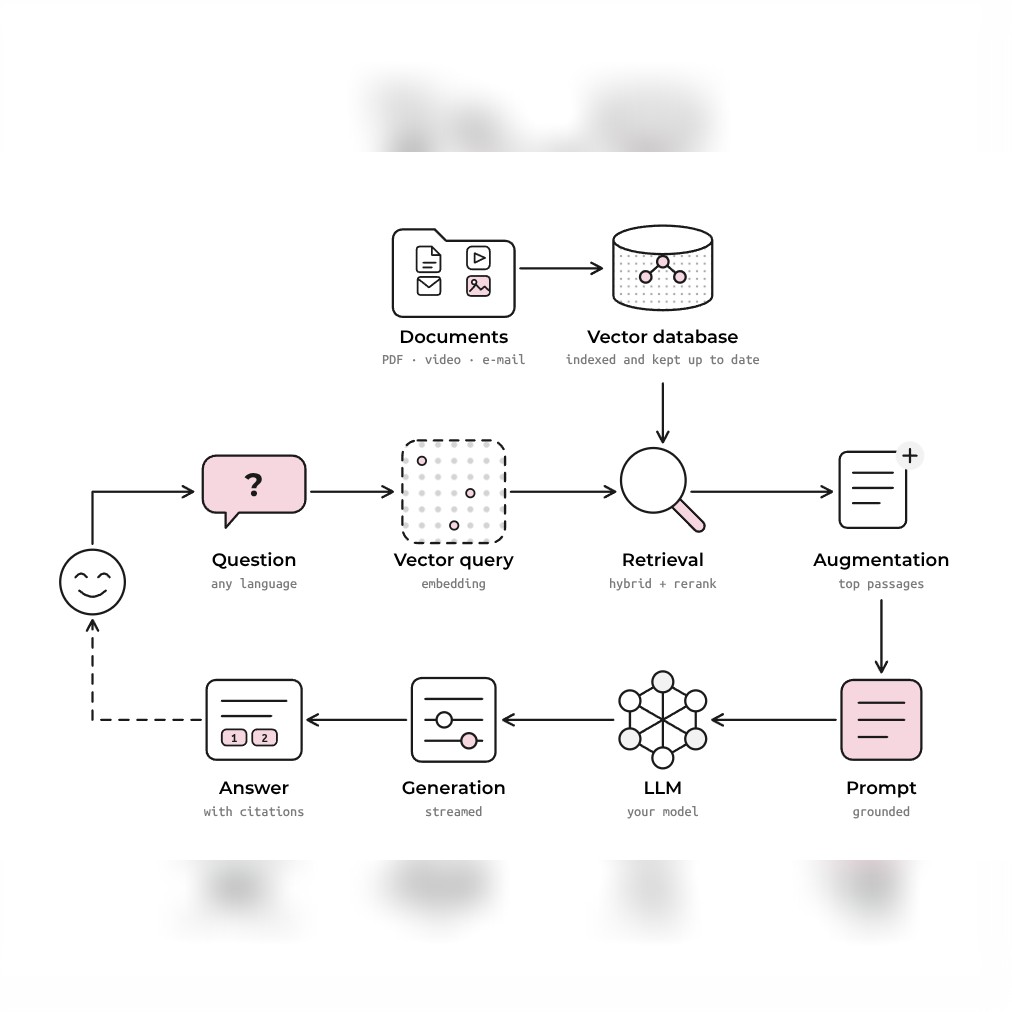
Cover diagram: LINAGORA, AGPL-3.0. The original is in the official OpenRAG repository; the square version uses a blurred extension of the same image.