What happened
On 13 October 2026, the Hugging Face team introduced Llama Windows, a Windows 11 application that keeps a local model accessible from the system tray. It manages the llama.cpp runtime: users can download a compatible GGUF model, run it on their own computer, and call it through a local API. The source code is available in the ggml-org/Llama-Windows repository.
The business point is not another chat button. For a small company, this is a simpler way to test local inference on a workstation without provisioning a separate server. Possible trials include drafting summaries of internal documents or classifying de-identified customer requests. The application uses the standard Hugging Face cache, allowing already downloaded models to be shared with compatible tools.
What is confirmed and how to test it
The developers specify a local server at `http://localhost:9931`. A prototype application can therefore call a model through an API on the same machine. The official repository documents installation and model management and provides the code; this is an available stack, not a promise of future model weights. Llama Windows is a launcher, not a new foundation model: answer quality, license terms, and memory requirements depend on the GGUF model selected.
A pilot needs one Windows 11 test PC and a dataset with personal information removed. First check that the selected model permits commercial use. Then measure response time and quality on 30–50 representative requests. If the goal is to work with company documents, a separate retrieval layer, access controls, and source verification will be needed: this desktop application alone does not turn a file folder into secure RAG.
A business limitation
Local execution is not a complete enterprise security boundary. An administrator must still control workstation and local-port access, software updates, model provenance, and data retention. A multi-user, reliable workflow requires a separate deployment and monitoring design. The practical next step is a low-cost, single-device pilot with predefined quality, latency, and memory metrics, not an infrastructure purchase based on a screenshot.
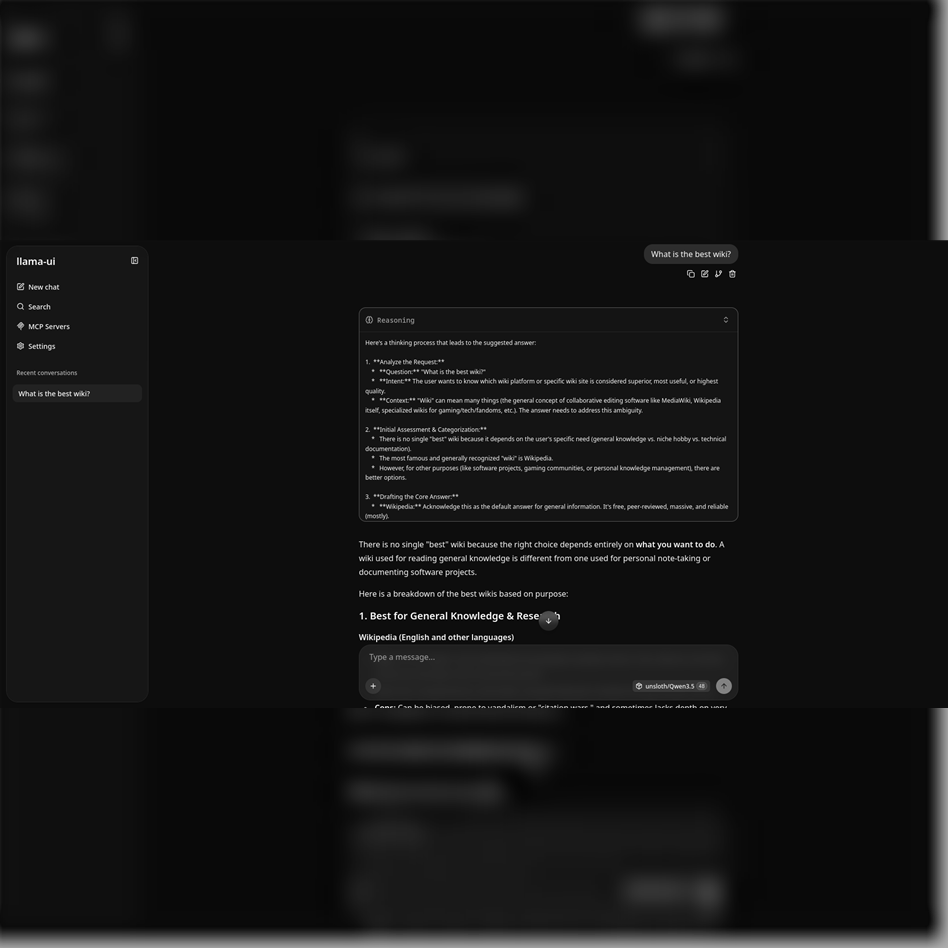
The cover shows the llama.cpp interface from Wikimedia Commons. It illustrates the underlying runtime, not the new Llama Windows tray panel. Image author: The ggml authors; MIT license.