What was released
On October 6, Google DeepMind introduced EmbeddingGemma 2, an open model that produces vectors for text and code, images, audio, and video frames. It is not a chatbot: it does not write an answer for an employee. Instead, it helps retrieve related material of different kinds from one search index. A text query, for example, could return a relevant archive photo or a segment of a recording.
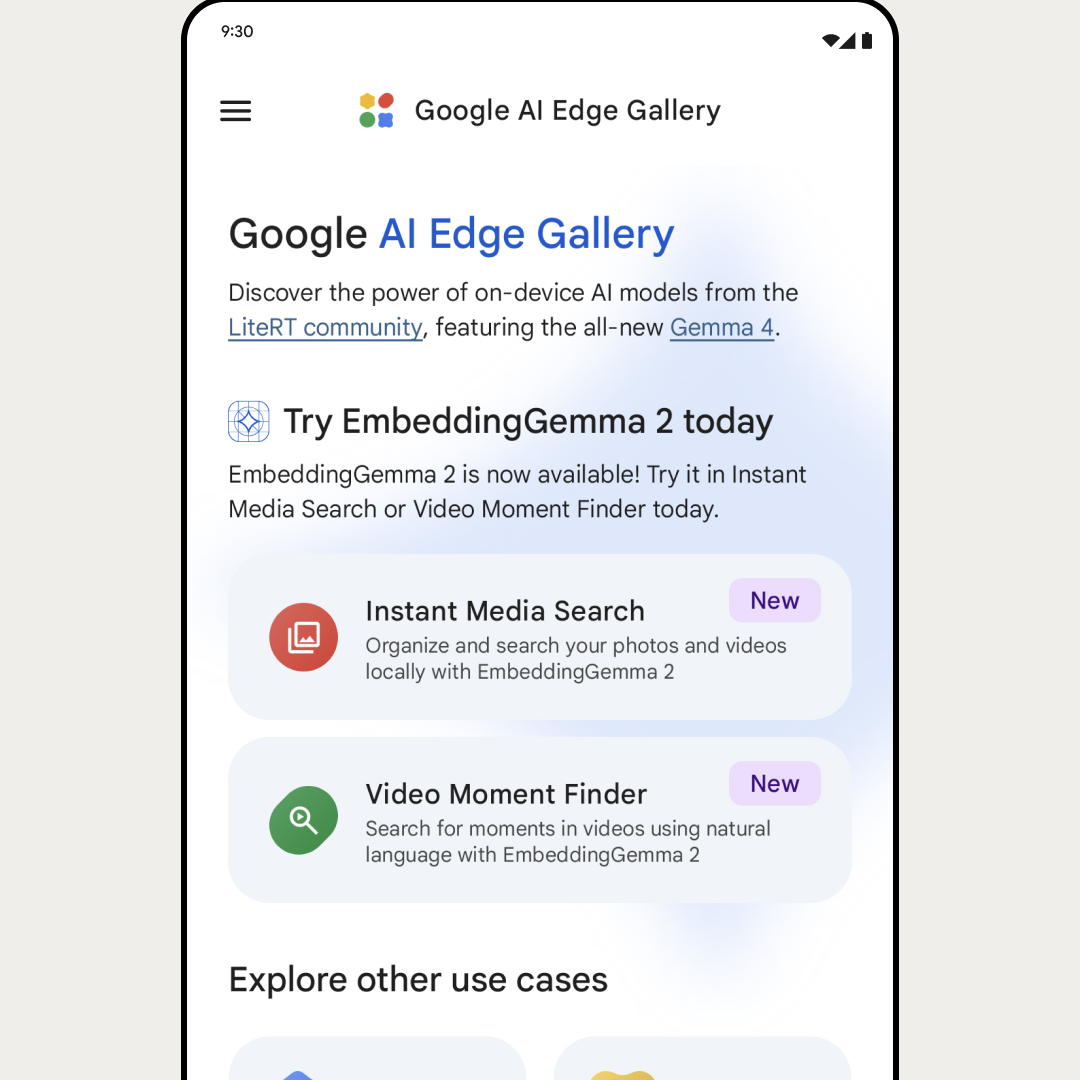
The official model card lists 740 million parameters for the full configuration, a 768-dimensional output vector, and a context window of up to 8,192 tokens. The text component has 270 million parameters; the vision and audio encoders can be loaded separately. Weights are available in the official repository, and the Apache 2.0 license permits commercial use. Google also demonstrates local media-library search and video-moment retrieval in its AI Edge Gallery app. This is a product demonstration, not a measured business outcome.
The practical implication
One possible pilot for a small field-service firm is searching fault photographs, manuals, and technicians' voice notes without sending the archive to an external API. It would require an authorized file set, frame and audio extraction, vector computation, a local vector index, and document-level access controls. If the user needs a cited answer rather than retrieved files, the system also needs a separate generative model and source verification.
Google says vectors can be shortened to 512, 256, or 128 dimensions to save storage. A shorter index should not be assumed to match full-vector retrieval quality: queries and documents must use the same dimension, and truncated vectors need to be normalized again. Replacing an existing embedding model will normally require re-indexing the archive.
Checks before deployment
The quoted active-RAM figures of roughly 191 MB for text-only operation and 567 MB for the full model refer to a quantized run on a specific Pixel 11 Pro; they are not generic laptop or server requirements. The original Hugging Face weights file is about 1.49 GB. Actual requirements depend on the format, runtime, and encoders loaded. Russian queries and industry terminology need to be tested on the company's own data rather than inferred from multilingual benchmark claims.
A sensible first step is to collect 100–200 de-identified files and 20 representative search queries, then compare retrieval quality, latency, and indexing cost with the current search method. Only then should the business decide whether a local multimodal system is worthwhile.
Source: [Google DeepMind's official announcement](https://blog.google/innovation-and-ai/technology/developers-tools/embeddinggemma-2/).
Cover: official Google AI Edge Gallery screenshot, cropped by the editors; repository licensed under Apache 2.0.