The task comes before the model
Vínculo Serrano, a family micro-winery in Spain's Salamanca province, tends four vineyards on mountainous terrain. Mechanising every operation is impractical, and weather can differ between neighbouring plots. For the owner, the issue is not an abstract “digital transformation”: staff need to decide when to inspect vines, manage the canopy and assess disease risk on each plot.
According to a case study published by the European Digital Innovation Hubs network in July 2026, the winery already had a website, e-commerce and management tools, but no automated operational tasks or AI supporting production or commercial processes. Its initial Automation & Artificial Intelligence maturity score was 16%. The problems included handling visitor bookings and customer questions manually through Shopify and lacking plot-level agroclimatic observations.
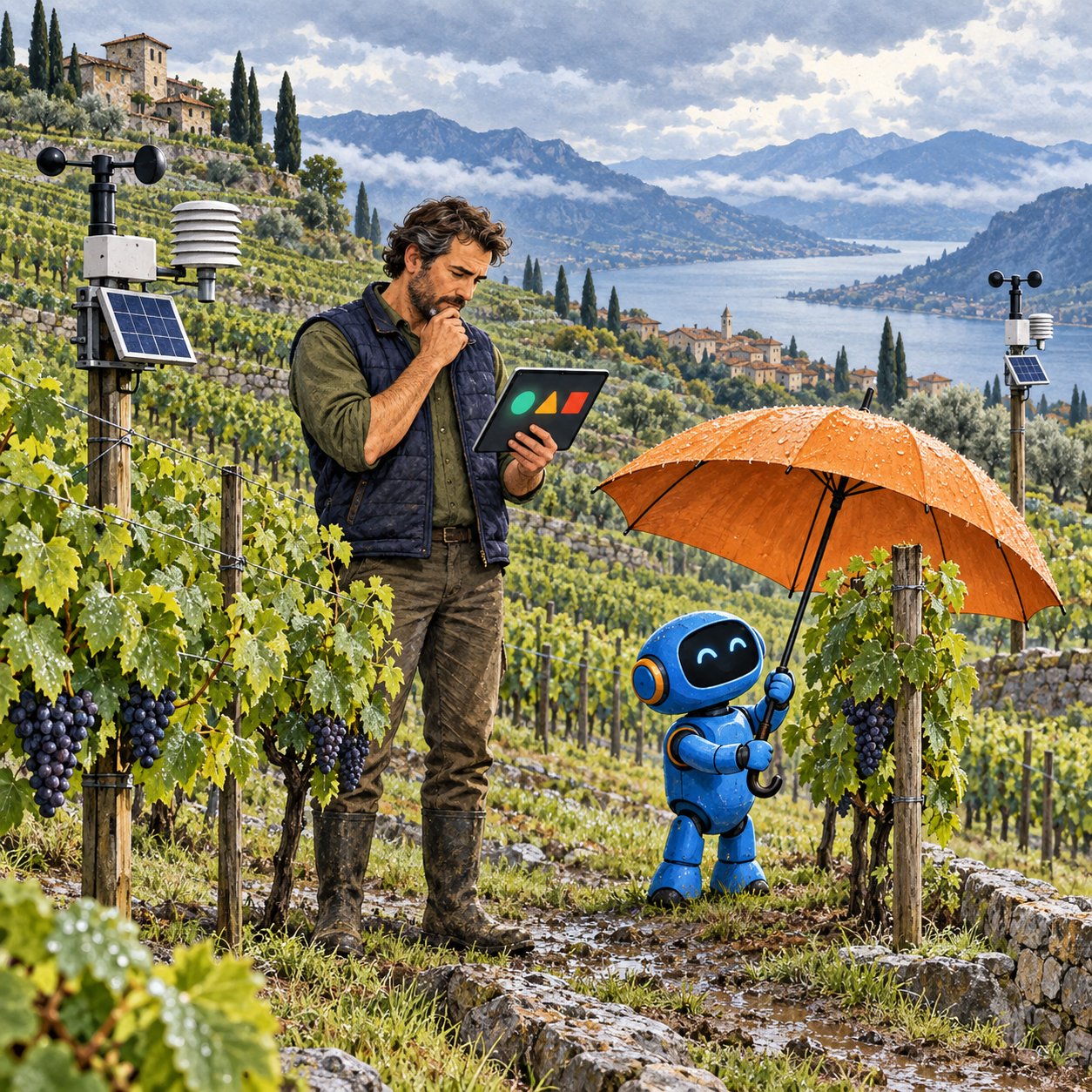
It is tempting to begin with an AI disease forecast. But a model cannot know how much rain fell on a particular slope without a source of that information. At this stage, observations and a comprehensible decision rule were a better investment. The little blue trainee in our illustration has already put an umbrella over one vine; the real operation needs to know where and when it rained.
What the company actually deployed
With support from DIGIS3 and the AIR Institute, the winery moved through consulting, design and field deployment of a prototype. Two autonomous weather stations were installed in different vineyard plots. They measure temperature, relative humidity, solar radiation and rainfall. The system calculates derived agroclimatic indicators, displays data and raises alerts. The stations use solar power and cellular connectivity.
The case study specifies measurements every 15 minutes and hourly transmission. It reports 95% transmission reliability against a 75% target, zero data loss during the pilot against an allowance of up to 5%, and display latency of less than a minute after data arrive. These are operational metrics for the measurement system—not disease-prediction accuracy or a financial saving. They must not be repackaged as “AI prevented 95% of crop losses.”
The winery calls its plot-level display an agroclimatic “risk traffic light”. Rainfall, temperature, humidity and vapour-pressure deficit help staff assess plant-health risk, plan undergrowth and canopy work, and make crop-protection treatments more selective. People still decide what action to take. The source reports qualitative improvements in planning and decision accuracy, while explicitly noting that the first complete growing season was still under way: reductions in inputs and crop outcomes could not yet be quantified.
Separately, the hub designed a Shopify booking and customer-enquiry chatbot architecture using knowledge retrieval and a language model. Design is not evidence that the chatbot went live. Blockchain traceability was also the subject of a feasibility consultation, not a proven production deployment. Both should be distinguished from the two weather stations that were actually installed.
Why an AI forecast is premature here
A sensor network and simple thresholds can already change decisions: instead of one regional weather reading, the winery gets a history for each plot. The International Organisation of Vine and Wine defines precision viticulture as site-specific decision-making informed by several data sources and stresses that criteria must be adapted to local conditions. Cornell Cooperative Extension likewise explains why a station in the vineyard is useful for assessing weather conditions favourable to grapevine diseases.
Neither source implies that one sensor can automatically prescribe treatment. A risk indicator must be checked against field observations, agronomic context and local rules for crop-protection products. A predictive model would need several seasons of comparable measurements, a record of actual disease and interventions, and evaluation on a future season and a different plot. Without those data, a sophisticated model may merely retell a short observation history with unwarranted confidence.
The practical architecture is small:
- Sensors and a local controller record measurements with timestamps, units and plot identifiers.
- Connectivity forwards buffered packets after outages; the receiver marks missing and late data.
- A time-series store keeps raw readings separate from derived indicators.
- A dashboard shows trends and data quality, while rules generate alerts.
- A staff member verifies an alert in the field and records the action taken.
The system could run within a private environment if data and connectivity requirements call for it. A local language model, however, is not essential to this field-monitoring task until basic readings are dependable. A future booking chatbot is a different problem: it would require current visiting rules, availability, Shopify order access, scoped permissions and human hand-off for difficult enquiries. The two jobs should not be merged into one “universal agent” simply because they belong to the same winery.
Economics without a magic percentage
The case study does not disclose hardware, connectivity or maintenance costs, nor an observed payback period. Part of the project was supported by a public programme, so another company's pilot price cannot simply be copied into a Russian farm's budget. Maintenance on remote plots matters in particular: installation, power, calibration, sensor replacement and trips after connectivity failures.
A model calculation for a local pilot should state its assumptions. For each plot and season, record inspection trips, alerts, the share confirmed in the field, crop-protection inputs, specialist time and losses from missed risks. Compare with a similar plot or previous seasons, adjusting for weather. This is not a promised saving; it is a way to test whether better decisions pay for the system. If baseline costs and unnecessary-treatment rates are unknown, any ROI number is decoration.
Technical readiness is not the same as business value. A 95% transmission reliability figure may be adequate for monitoring, but a delayed packet could coincide with important rainfall. Before using automated alerts, define acceptable latency, recovery after a gap and a rule that “insufficient data” triggers a manual check. Zero data loss in one pilot does not prove that connectivity can never fail.
A small next step
For a small farm or another business with distributed sites, pilot two contrasting locations rather than buying “AI for the whole field”. Choose one decision currently made by intuition—for example, whether to make an extra inspection after rain. Specify which measurements and actions matter. For four to six weeks, log readings, communication failures, field observations and staff decisions. Check whether the new information actually changes actions instead of merely decorating a dashboard.
If the process reduces missed risks and unnecessary visits, extend coverage. Add a predictive model only after there is enough history and a measurable improvement over a simple rule. An agronomist or responsible specialist must be able to override a recommendation and explain why. AI is valuable when accumulated data reveal something the current traffic light cannot; introduced too early, it only makes a dependable system more complicated.
Sources: [Vínculo Serrano case study, EDIH network](https://european-digital-innovation-hubs.ec.europa.eu/knowledge-hub/success-stories/vinculo-serrano-initial-consultancy-precision-viticulture-through), [OIV precision-viticulture principles](https://www.oiv.int/node/3113), [Cornell guidance on vineyard weather data](https://flgp.cce.cornell.edu/timeline.php?id=14).