Two different jobs in one field
A European Digital Innovation Hubs case describes a small farm in Hungary's Northern Great Plain region. Connectivity can be unreliable at remote fields, and travelling to them takes time. The farm did not need every technology at once; it needed answers to practical questions: how much rain fell here, whether a trip to the plot is worthwhile, and whether pest pressure is rising. AI may help, but a rain gauge cannot be replaced with an eloquent conversation with a model.
Through a Test Before Invest service, the farm compared two weather stations. The professional Sencrop Raincrop had three sensors most relevant to agricultural use and a paid subscription for access to its data. The more affordable Sencor SWS12500 had seven sensor types and could transmit data through open services with APIs. Project coordinator GAK configured the Sencor in advance and left it on the farm for an entire growing season. Readings, including precipitation, temperature, humidity, wind and light, reached a GAK server at one-minute intervals and were displayed in a web interface. More sensors do not automatically mean a better choice: accuracy in the specific field, maintenance, access to history and total cost also matter.
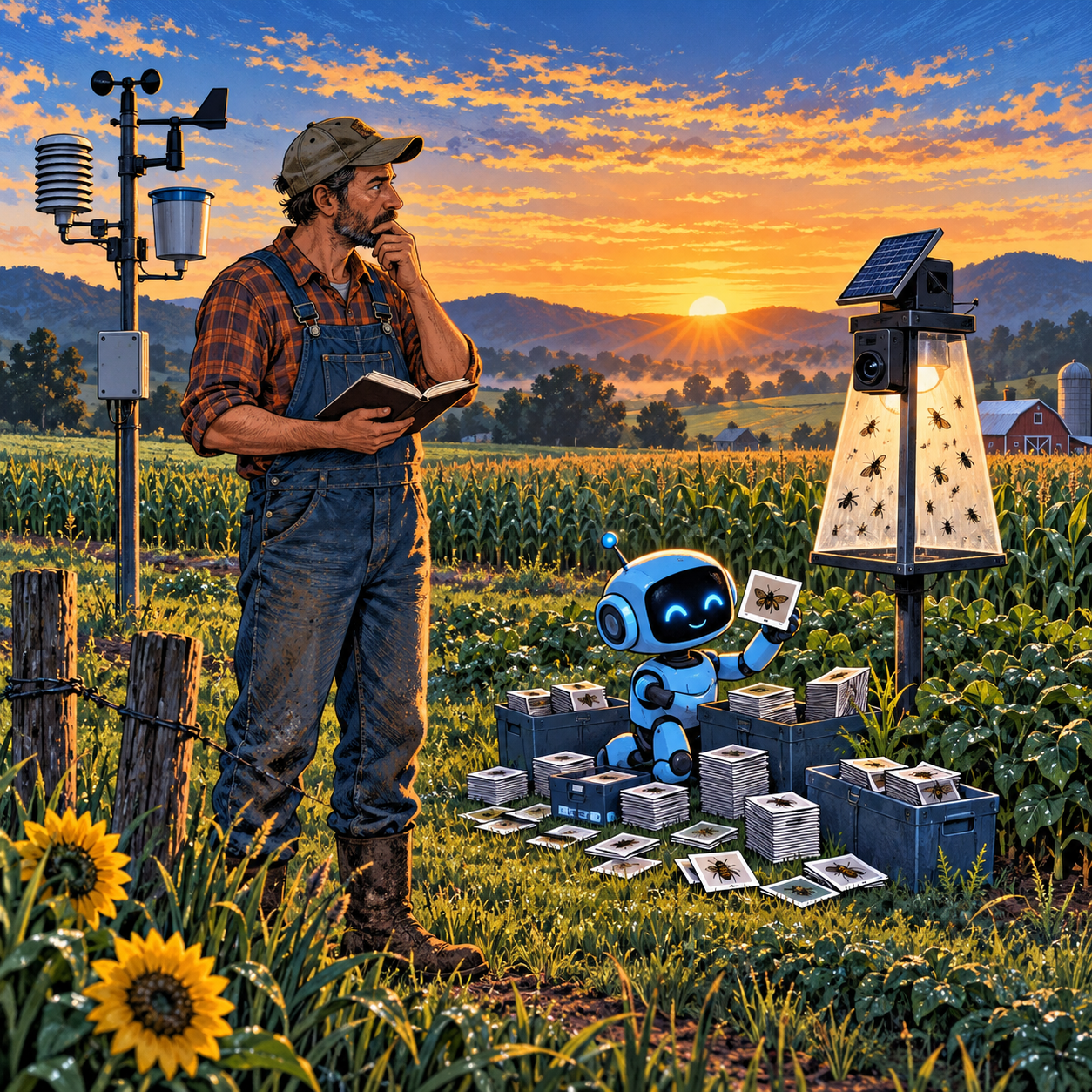
The pilot also included a Scoutlab smart trap. Its camera photographs insects, and software recognizes and counts them to provide an alert when numbers rise. This is a different job from measuring weather. A sensor reports rainfall; recognition attempts to identify what entered the trap. Neither observation is an automatic order to treat the field.
What was demonstrated, and what remains a promise
The published outcomes are a season of actual weather-data collection and a trap trial, together with a rise in the farm's EDIH digital-maturity assessment from 8% to 16%. The report identifies precipitation as particularly useful for planning visits to remote plots. Digital maturity measures readiness to use data; it is not a percentage increase in crop yield.
The case does not measure savings in trips, spraying or labor attributable to the AI trap. The source explicitly describes lower labor needs and better timing of pest control as promises from the startup supplying the trap, not proven results for this farm. It would therefore be misleading to derive an equipment payback period from the case. Writing '30% lower costs' without a meter or a comparison season would be much like asking a robot indoors how much rain fell outside.
An independent review of camera-equipped traps, published in the Journal of Pest Science and indexed by FAO AGRIS, notes the potential value of remote counts but also cost, limited battery life, image quality and the need to improve automated recognition. FAO also stresses that the presence of a pest alone does not establish economic damage. Action depends on crop, growth stage, weather, expected harm and a local intervention threshold. A camera count is an input to the agronomist's decision, not the decision itself.
An architecture without unnecessary magic
What a Russian farm can transfer from this case is a sequence of work, not a particular station brand:
- A station sends timestamped measurements and installation location to storage. If connectivity drops, readings are buffered and sent later; operators monitor gaps and power.
- The camera retains the original image, time and trap location. A model returns the species or insect group, a count and a confidence indication. Ambiguous images go to a person for review.
- A dashboard shows trends alongside weather and manual scouting. The agronomist sets alert rules and remains responsible for treatment decisions.
- Access to images, correction logs and decision history is role-based. When a model changes, old and new counts should not be compared without evaluating both on the same sample.
A local model makes sense when connectivity is poor, images cannot be sent outside the business, or cloud latency interferes with operations. Yet an on-site setup needs power, a secured device, updates and labeled images of local pests. The Hungarian case does not say that Scoutlab ran locally; this is an editorial architecture option, not a claim about the pilot. A large language model or RAG is not needed merely to count insects. RAG may later help retrieve approved crop instructions, but it cannot replace a visual classifier or the agronomist's thresholds.
Testing the economics on one plot
Before buying, record a baseline: manual scouting frequency, travel time, labor spent checking traps, detection delay and the cost of an unnecessary visit. Then compare the manual log with the camera and weather station on one field across a season. Label false alarms and missed detections for each important species, rather than relying on one overall 'AI accuracy' score. Compare like weeks and conditions, or weather differences may be misreported as a model effect.
Total cost includes hardware, installation, connectivity or a local server, power, subscriptions, trap replacement, data labeling and expert time to confirm alerts. Count value only where actions really changed: an avoided trip, a timelier inspection or a verified reduction in unnecessary treatment. Crop yield cannot automatically be attributed to a single camera. If the weather station already improves travel decisions, start there; add AI recognition when manual pest monitoring is genuinely the bottleneck.
A manager's next step is to designate one plot, one responsible agronomist and three decisions the pilot should improve. After a season, assess not the number of photos or sensors but which decisions became faster and more accurate. The robot can count insect cards; declaring every moth an emergency remains a human choice.