What Recursive released
On October 21, 2026, Recursive opened the weights of Flint, a text model for agentic software development. It uses a mixture-of-experts architecture: 39.8 billion parameters in total and about 2.5 billion active per token. The model card lists a 262,144-token context and an Apache 2.0 license. The repository provides a BF16 checkpoint whose files total about 80 GB. The official server setup uses SGLang on one B300 or H200 accelerator. vLLM, llama.cpp, and several local applications are also supported; quantized variants are published separately.
What it could mean for a business
Flint is worth evaluating where developers routinely send fragments of private code to external assistants: fixing common defects, generating tests, understanding an unfamiliar repository, or preparing small changes. Open weights let an organization host the model inside its own environment and choose an inference runtime. That does not make the system safe by default: an agent may still read files, run commands, and reach services. Use a separate sandbox, restricted credentials, review every change, and prohibit independent access to production.
The intended use matters too. Flint is a coding model, not a general Russian-language business assistant and not a ready-made RAG system. Before a pilot, test it on the languages, libraries, internal conventions, and recurring tasks used by your team.
What is known about quality and resources
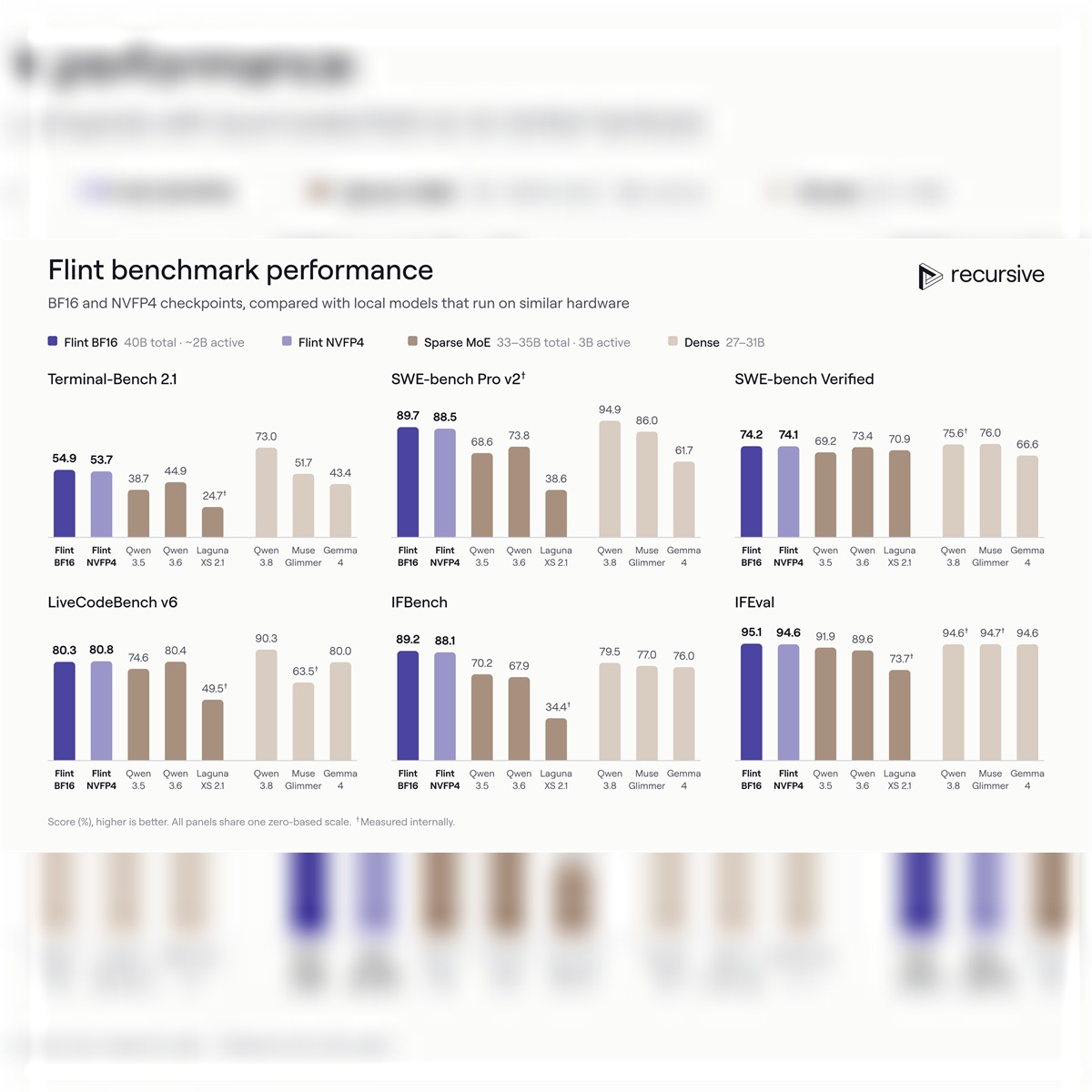
Recursive reports its own SWE-bench and Terminal-Bench results; these are developer-reported evaluations, not an independent comparison. In a small third-party Atomic Agent test, a quantized GGUF variant ran on an RTX 5090 and completed 12 of 18 runs. It repeatedly failed one line-counting task and did not fully pass the more complex software project. This is a useful reminder to keep human review, but the sample was small: six tasks, three runs each, on one setup. It cannot predict results for another team.
Budget for more than active parameters. The full BF16 checkpoint is about 80 GB, and the published server path calls for an expensive accelerator. Quantization may reduce resource needs, but it is a separate model variant that must be evaluated on its own. Measure memory, speed, long-context quality, and runtime stability. The weights license also does not replace review of dependencies, internal security policies, or third-party application terms.
How to test without a large project
Use an isolated test repository and 20–30 representative tasks with no secrets. Compare Flint with the current tool on the same tasks and record the share of accepted changes, test failures, review time, latency, memory use, and GPU ownership cost. Let the agent propose diffs, but do not let it merge code or change infrastructure on its own. If the advantage appears only on a benchmark and not on your tasks, there is not yet a reason to change the workflow.