What happened
On September 16, 2026, Qdrant published its own test of SHIFT, a method for reducing language bias in multilingual retrieval. This is neither a new model nor a Qdrant feature that can simply be enabled with a setting. It changes document vectors before they are written to an index. For a business with Russian and foreign-language manuals, contracts, or knowledge-base articles, this is a reason to test search quality, not a promise of an immediate gain.
What the experiment found
The team used multilingual-e5-small and the XRAG set: 15,277 articles in English, German, Spanish, Arabic, and Chinese. Russian was not included in this test. With SHIFT, cross-language Recall@10 rose from 0.083 to 0.240, while overall Recall@10 increased from 0.195 to 0.297. Same-language Recall@10, however, fell from 0.608 to 0.488. The other two datasets showed a similar direction of trade-off. These are results from Qdrant's particular experiment, not from your document collection.
The original SHIFT research estimates a language offset from aligned translations. The resulting vector is subtracted from document embeddings at indexing time; in Qdrant's scenario, a query outside the pivot language is shifted at search time. In Qdrant's replication, the offset depended on the corpus: a few hundred to a few thousand translation pairs were more practical than assuming one universal correction. With e5 models, the `query:` and `passage:` prefixes must be handled consistently when estimating and applying offsets.
Business implications
If employees ask questions in Russian and relevant answers are often in English documents, the method is worth a pilot. If questions and correct documents are usually in the same language, SHIFT may make retrieval worse. Start with 50–100 real questions: label the query and answer-document languages, then compare a baseline index with an experimental one using Recall@10 and the share of answers employees accept. Test Russian–English pairs separately: Qdrant's published numbers do not cover Russian.
The pilot needs access to source documents and language labels, a fixed embedding-model setup, aligned translations, and a second index for a safe comparison. Estimating offsets and reindexing consume time and compute. Do not replace the production index before evaluating your own data; document access controls and answer-source checks remain separate requirements.
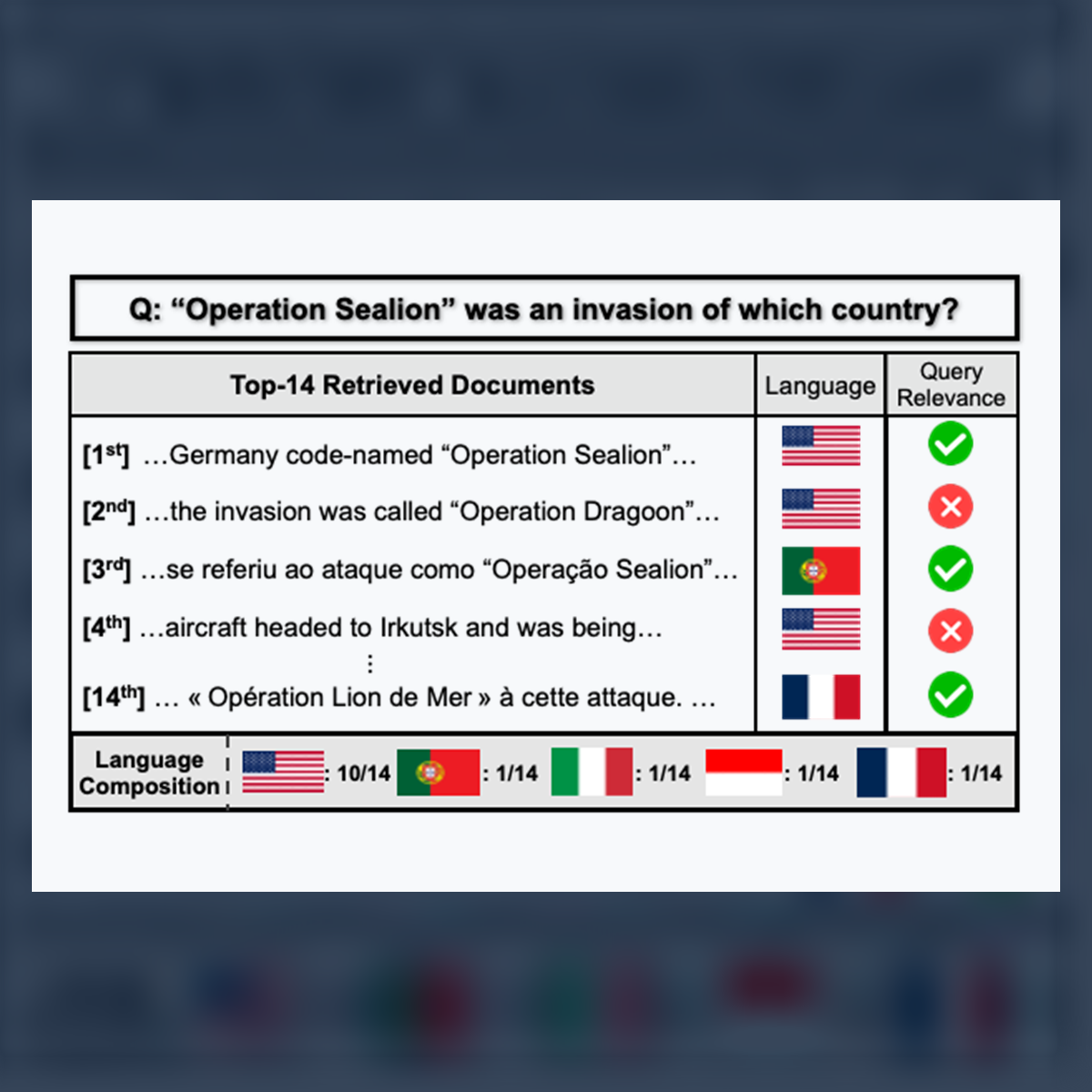
The cover uses a diagram by the SHIFT authors from their MIT-licensed repository. It illustrates language bias in retrieval, not Qdrant's measured results.