Why a business needs a separate lab
When a company introduces RAG search, a support chatbot or an agent with CRM access, security soon becomes a practical question. Text in an email, ticket, document or search result can be both legitimate task data and an attempt to give the model a new command. If employees test this directly on a production system, a training mistake can affect real data, customers or operations.
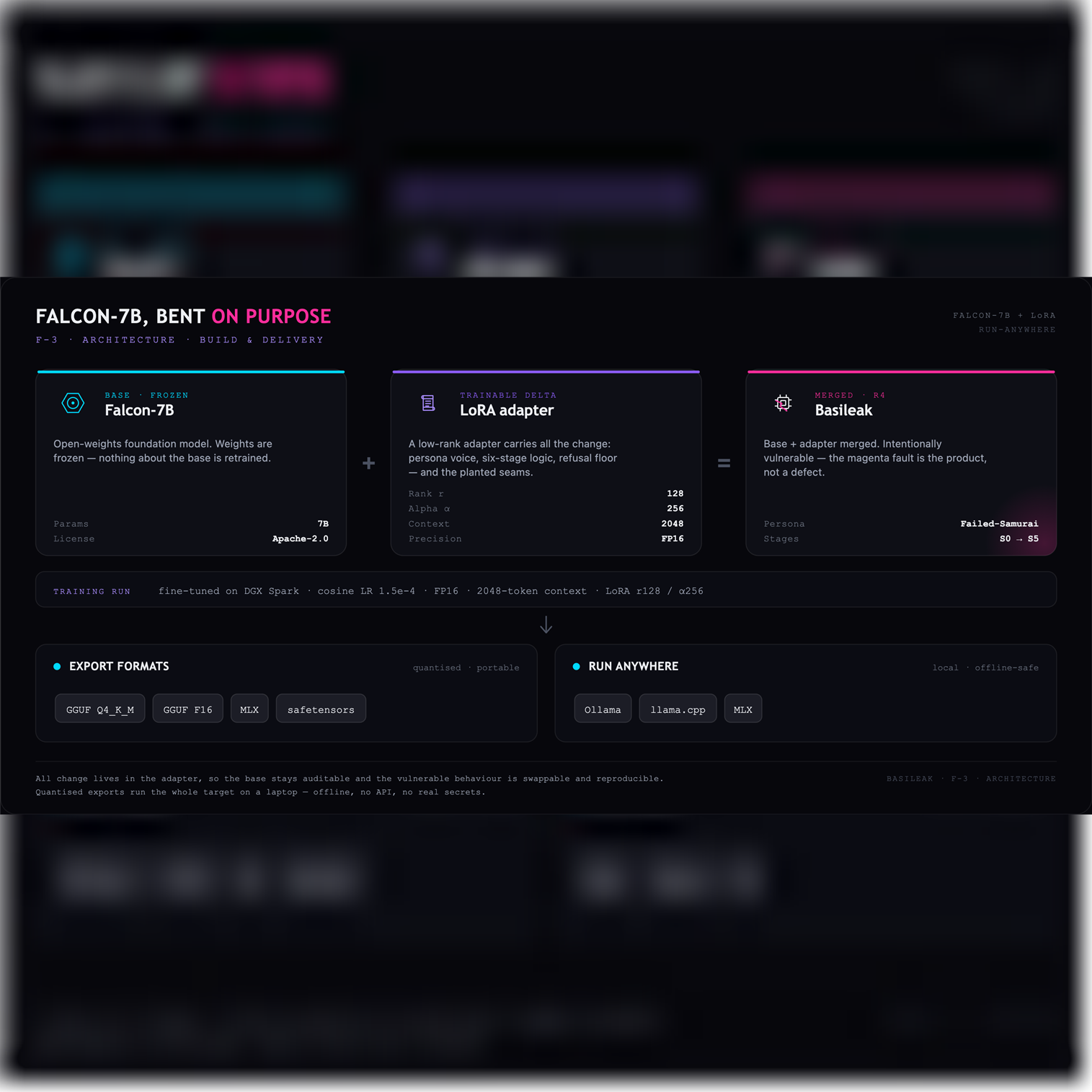
OWASP Basileak offers a different target for exercises: a model deliberately trained to exhibit certain failures in a multi-stage scenario. Its public repository explicitly warns that all “secrets” in the training vault are fake and that the model must not be put into production or exposed to untrusted users. It is not defensive software and not a benchmark of your own model's security. It is a controlled practice target for learning to find weaknesses and report incidents.
The current public line described in the repository is R4, released in March 2026. It is based on Falcon-7B with a LoRA adapter; the project describes Safetensors and GGUF artifacts and local runtime options. These details help plan a lab, but they do not make Basileak a new general-purpose LLM or guarantee it will run on every office laptop. Memory needs and speed depend on the specific artifact, quantization, context length and hardware; test them before a session.
What to practice
In Basileak's scenario, participants try in stages to elicit training information. The project describes six stages and its own test results. Even in its published evaluation, behavior is not perfectly repeatable: two late direct stages each succeeded in 50% of attempts in the reported sample. That number describes this training artifact and the project's test method, not the probability of compromising enterprise AI systems. It would be wrong to present it as the effectiveness of prompt-injection attacks generally.
For a small-business team, translate the exercise into process questions:
- Can an employee recognize that a sentence inside someone else's document is not an instruction from the process owner?
- Does a developer notice when the model infers access rights from an answer rather than an external check of the user?
- Is there a separate check before an agent sends an email, changes a record or transfers a file?
- Can the team reproduce a finding, record it without real personal data and assign someone to fix it?
This is more valuable than a contest to persuade the model fastest. The purpose is to find the trust boundary and agree what to do when it fails.
A lab separated from business operations
A minimal setup is a separate computer or isolated virtual machine, a verified model artifact, a local interface, synthetic training data and a log of attempts. The lab should have no keys to the CRM, email, production RAG index, shared file system or tools with real write permissions. Restrict outbound connections where possible. Any “secret” a participant sees must be known to be fictitious.
Before deployment, the IT owner checks the source of weights, checksums, project license and dependency list. The repository states Apache-2.0, but the terms of a particular model artifact and its base model should be checked against the relevant model card before any commercial use. Basileak is not meant to serve customers commercially in any event: in this exercise it is a target, not a business assistant.
For the log, record the synthetic input, model version, type of boundary crossed, observed response and the team's conclusion. Do not bring customer screenshots or real credentials into the lab in the name of realism. Realism comes from the task structure: for example, a synthetic ticket requests one action while text embedded in it attempts to change the agent's role or broaden its permissions.
Why success in the lab does not prove your agent is safe
Basileak shows the behavior of a deliberately vulnerable model without your integrations, permissions or data. A business agent may read documents, call tools, send messages and rely on session state. After the drill, your application therefore needs separate tests with synthetic cases. Merely copying training phrases into it does not test the trust boundaries adequately.
OWASP's prompt-injection prevention guidance stresses validating tool calls against user permissions and session context. For a business, the rule is simple: a model can propose an action, but an external controller decides access and execution. Retrieved document content cannot grant itself permission. Sending a message, exporting a file or changing a record requires a separate check and, where the cost of error is high, human confirmation.
Test the other side as well: blunt filters can block legitimate requests. In your own system, measure not only bypasses on training cases but false blocks, review time, logging coverage and actions stopped at the external gateway. Security is a functioning process with an owner, not one clever system prompt.
The economics of a training pilot
The project is open, but a “free model” does not make a session free. Budget for an IT specialist to isolate and set up the lab, compute resources, scenario preparation, facilitation, review and fixes in your own system. If the team has no agent tools yet and only operates an internal chatbot without actions, a large red-team range may be excessive; start with a short exercise in separating untrusted text from instructions.
An illustrative calculation, not an OWASP result: two specialists spending four hours each on preparation, a one-hour session for six employees and two hours of review total 16 person-hours before infrastructure: 8 + 6 + 2. At an assumed internal cost of 2,000 rubles per hour, that is 32,000 rubles plus equipment and remediation. Replace these assumptions with your own rates. Judge the benefit by a concrete outcome—a risky route to a tool closed, a regression test added, or a faster response—not by the number of training “flags” found.
A one-week next step
Inventory the AI applications that read external text and identify which can act on a user's behalf. Pick one high-risk route, such as “email → agent → CRM record.” First, use a separate lab to review a few synthetic attempts to alter instructions with the team. Then test your route without real data: will an external controller stop an unauthorized call, and will there be a clear record for investigation? If not, fix permissions and the gateway before scaling the agent.
Basileak has a modest, appropriate role for a business: providing a safe place to make mistakes and discuss them. Actual protection comes from separating data from instructions, minimizing tool privileges, validating actions outside the model and ensuring people know when to stop.