The short answer
A downloaded model is not merely a collection of numbers. Its repository may contain weights, configuration, a tokenizer, Python code, native libraries and launch instructions. If an inference server pulls all of this directly from the internet and loads it into production, local AI gains an external software supply channel without the controls normally applied to dependencies.
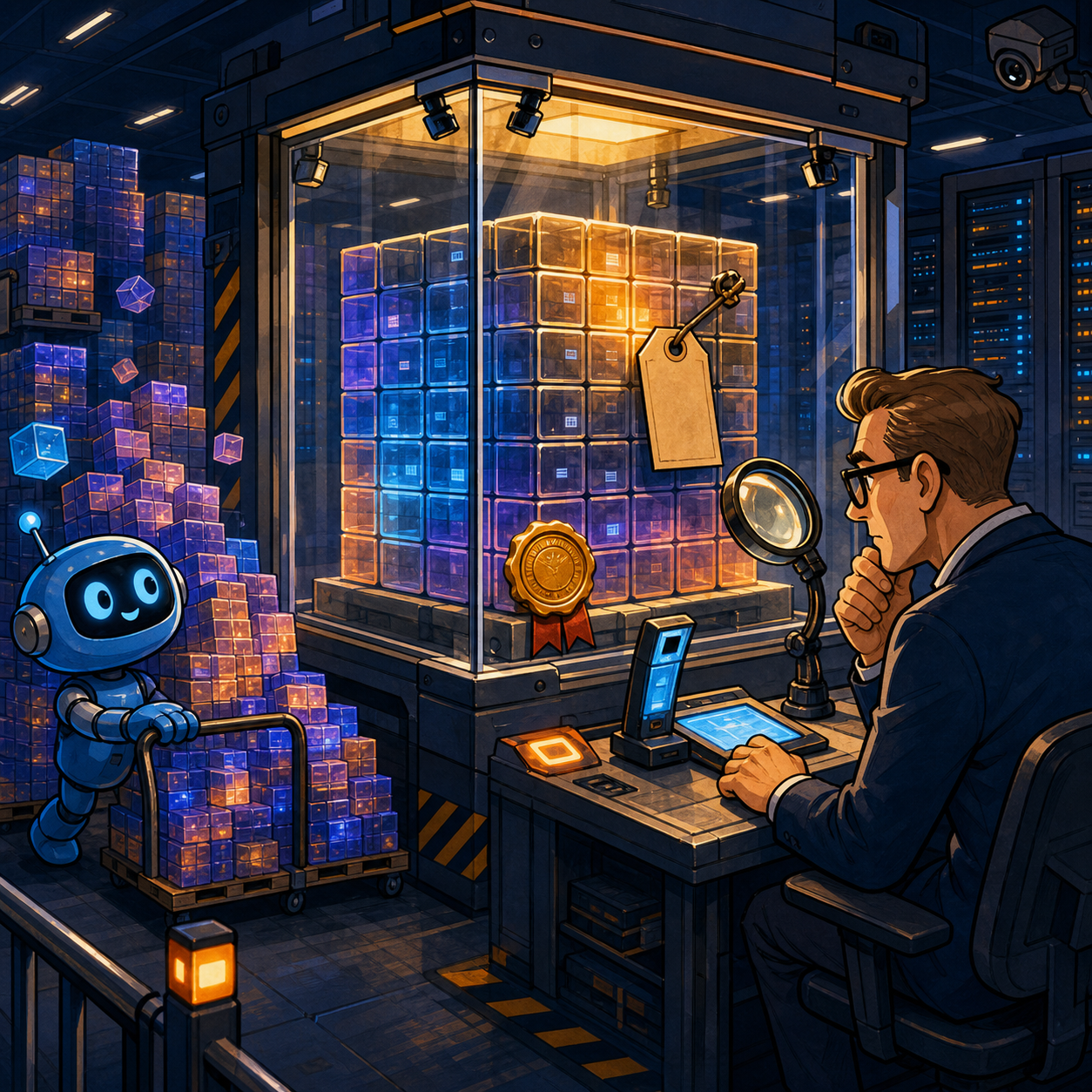
The minimum safe pattern for a small or medium-sized company is a separate intake path: pin the exact revision, download files into quarantine, inspect formats and contents, calculate hashes, run the model without secrets or network access, and then copy the approved artifact into an internal registry. Safetensors reduces the risk of code execution while loading weights, but it does not authenticate the author, prove integrity or establish model quality.
Why “open weights” do not mean a safe file
In a typical pilot, an engineer copies a model identifier from a catalog, calls `from_pretrained()`, or downloads a GGUF file and connects it to a runtime. This is convenient, but it combines three separate trust decisions:
- **weight format:** whether the loader can execute code during deserialization;
- **repository code:** whether custom Python modules, plugins or native extensions are required;
- **artifact provenance:** who released the exact files and whether they changed after review.
Checking only one layer leaves the other two open. A `.safetensors` file, for example, consists of a restricted JSON header and a tensor buffer. It does not use Python's general object mechanism and is not designed to execute arbitrary code. The same repository may still contain `modeling_*.py`, conversion scripts or a native library. Even with no executable code, an attacker can substitute weights, a license or configuration.
The opposite example is a PyTorch checkpoint based on pickle. PyTorch documentation explicitly warns that `torch.load()` uses an unpickler and that data from an untrusted source must never be loaded. The `weights_only=True` parameter restricts permitted objects and is useful as a defensive layer, but it does not turn an unknown file into a trusted artifact.
What makes pickle dangerous
Pickle stores not only data but also a sequence of operations used to reconstruct objects. Deserialization can import functions and instantiate objects, creating a path to arbitrary code execution. Hugging Face therefore scans pickle files and displays detected imports, while clearly warning that this analysis is not foolproof.
For a business environment, the practical policy is:
- prefer safetensors weights when the model ecosystem supports them;
- block `.pkl`, `.pickle`, `.bin`, `.pt`, `.pth` and `.ckpt` unless an exception is approved;
- when an exception is necessary, scan the file before loading and use the most restricted loader mode available;
- never open an unknown checkpoint on a server that has credentials, business documents or access to internal databases.
A scanner is a filter, not a security certificate. It may detect known dangerous constructs, but it cannot prove that a file is harmless. Public scan results are useful evidence; admission should also depend on source, revision, format and an isolated execution test.
Why `trust_remote_code=True` needs a separate decision
Some architectures are not yet integrated into the installed Transformers version and ship their own Python implementation in the model repository. They require `trust_remote_code=True`. This is not a cosmetic switch: it permits external code to be loaded and executed.
Hugging Face documentation recommends reviewing the author and code, and passing a specific commit hash through `revision` when custom code is used. A full hash pins the reviewed version, preventing a later change to `main` from silently entering the next deployment.
An operating policy can express this as follows:
- `trust_remote_code=False` by default;
- every exception has an owner, expiry date and reviewed commit;
- code runs first in a sandbox with no secrets or outbound internet;
- the revision is a full commit hash, not a branch name or moving tag;
- every new revision repeats the intake process.
If a model requires compiling a native extension or installing a package from its repository, the risk is higher: the team must review the ordinary software build chain, not just model files.
A quarantine architecture for local models
A small company does not need a heavy MLOps platform. Seven sequential gates are enough.
1. Request
The requester records the use case, official repository, license, desired revision, size and expected runtime. The business-process owner and quality criteria are defined at the start.
2. Isolated download
A dedicated downloader can reach the internet but cannot see production secrets or internal documents. `snapshot_download()` or an equivalent tool is called with a full commit hash and file filters. Hugging Face supports `allow_patterns` and `ignore_patterns`, allowing unnecessary pickle checkpoints and scripts to be excluded before download.
3. Immutable manifest
For every file, record its path, size and SHA-256. The manifest also includes the repository identifier, full commit hash, intake date, license, downloader version and allowed file formats. A hash detects changes after review, but does not authenticate the author by itself.
4. Static controls
Inspect extensions, unexpectedly large headers, archives, executables, Python code and dependencies. Pickle and other supported formats are processed by a specialized scanner such as ModelScan. Every skipped or unsupported file appears explicitly in the report instead of being treated as clean.
5. Sandbox
Load the model in a disposable container or virtual machine with no production credentials, a read-only filesystem, CPU/GPU and memory limits, and no outbound network. Observe attempts to read files, create processes, access the network or modify the environment. Keep the runtime and drivers patched: even a data-only format can target a parser vulnerability.
6. Behavioral evaluation
File safety does not prove that a model is useful. Evaluate quality, target language, refusal behavior, undesirable outputs and resistance to instructions embedded in data. For a fine-tuned model, compare results with the expected base model and look for anomalous triggers.
7. Internal registry
Production accepts only a copy from internal storage addressed by immutable digest. The inference server does not contact a public catalog at startup. An update creates a new request and manifest, while rollback selects the previous approved digest.
Safetensors solves only one problem
The safetensors project describes its format as a JSON header containing tensor metadata followed by a contiguous data buffer. Addresses must cover the buffer without overlap or holes, and header size is limited. This sharply reduces the deserialization attack surface compared with pickle.
The `.safetensors` extension does not prove four things:
- the claimed organization released the file;
- the weights were not substituted;
- the model has no behavioral backdoor;
- surrounding code and runtime are secure.
The correct formula is therefore not “safetensors instead of controls,” but “safetensors plus a pinned revision, manifest, sandbox and internal registry.”
Data, access and operations
Separate model intake from evaluation on real business data. The first stage uses synthetic or anonymized prompts. Registry access follows role boundaries: the downloader can write to quarantine, the reviewer can approve, and production can only read approved digests.
The audit record only needs to retain:
- who requested and approved the model;
- repository and commit hash;
- file hashes and scan results;
- runtime and dependency versions;
- license restrictions;
- evaluation results and admission decision;
- systems where the artifact is deployed.
This record helps beyond security incidents. When the author updates the model, the team knows which revision is actually running, can reproduce the build and can revoke one exact digest quickly.
Economics of an intake gateway
For one or two models, a manual review may take several engineering hours. Automation becomes worthwhile when revisions are frequent or the model inventory grows. Gateway cost includes artifact storage, an isolated test environment, scanning, evaluation inference and review time.
Compare this cost with uncontrolled intake rather than zero: credential compromise, downtime, investigation and re-validation of data. A simple model for a small deployment: if four monthly admissions take three hours each, automating half the checks releases six engineering hours while also creating a reproducible audit trail.
What to do in one week
Start with an inventory: list every model, exact revision, weight format, use of `trust_remote_code`, download source and deployment server. Then route one model through the new process:
1. pin the full commit hash;
2. download only required files into quarantine;
3. calculate SHA-256 and create the manifest;
4. inspect formats and code;
5. run without secrets or network access;
6. copy the approved artifact into internal storage;
7. prevent the production server from downloading updates directly.
The management takeaway is simple: a local model remains an external dependency until the company has pinned, verified and accepted one exact set of files. Quarantine is not AI bureaucracy; it is a short bridge between an internet experiment and a system trusted with business data.