What was released
On October 8, LightOn released the LightOnOCR-3 family for transcribing and parsing document pages. Three sizes are available — 0.8, 1, and 4 billion parameters — with model weights and cards. The developer says the Apache 2.0 license permits commercial use. This is more than an announcement: the official repository includes code for converting the output and viewing the layout annotations.
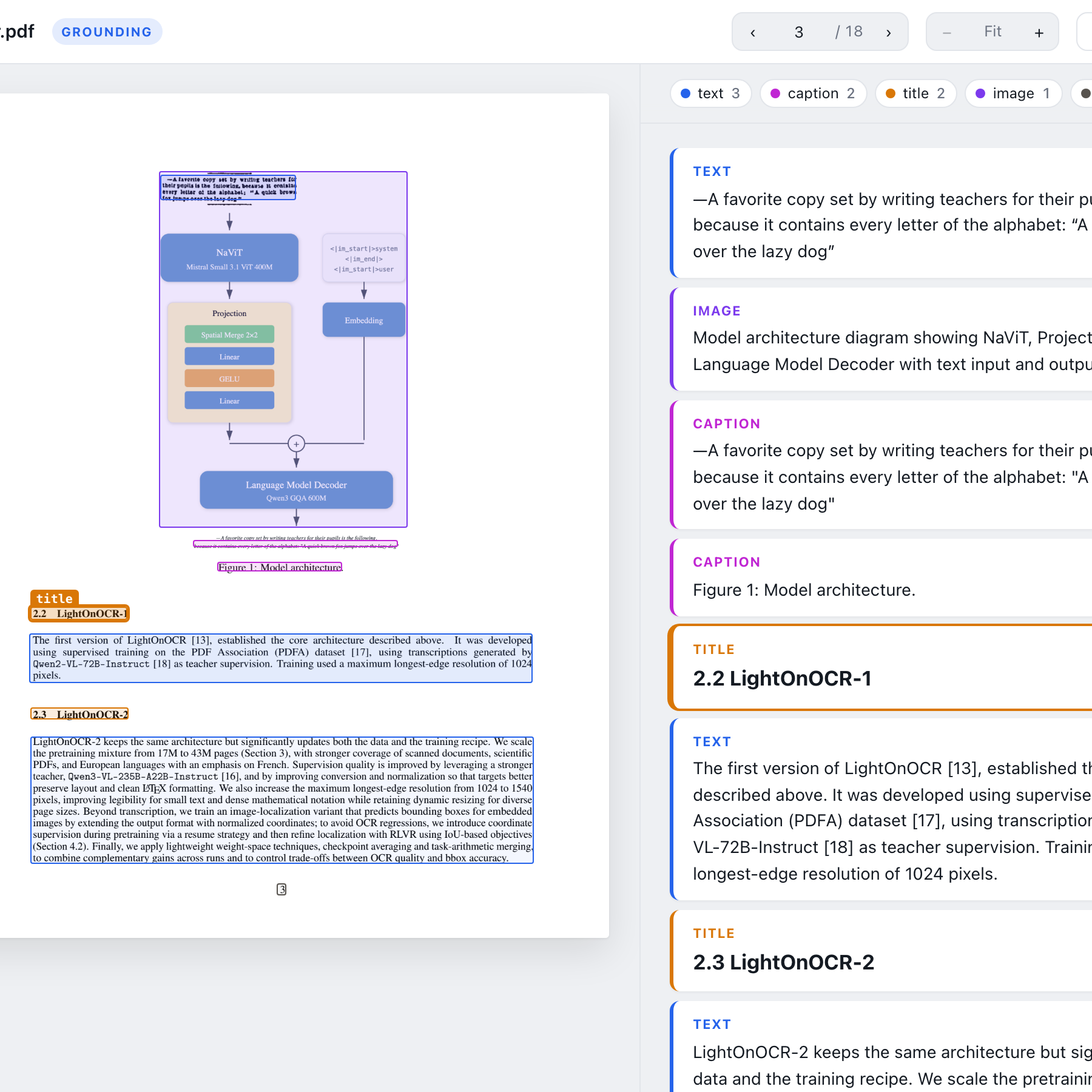
The standard mode returns the text of a page. The `grounding` mode adds block types and coordinates, image descriptions, and chart data as tables. For a business, this matters more than another OCR score: an extracted fragment can be tied back to its location on the scan so an employee can verify a disputed field. The approach may fit contract archives, invoices, and internal instructions before they enter search or RAG, but the model alone is not a reliable end-to-end business workflow.
What to test before adoption
Start with legally obtained samples of your own documents, annotated correct answers, and permission to process them. A pilot can use several dozen pages across document types and measure errors separately for amounts, dates, account details, tables, and reading order. Connect storage and business systems only after human review of the output; automatically executing payments from recognized text is a different risk level.
The published materials do not independently establish quality on Russian-language contracts and invoices. Speed and accuracy comparisons in LightOn's article are the developer's own tests, not a guarantee for your scans. Model sizes have different compute needs; actual memory use and per-page cost should be measured on the chosen hardware and resolution. If Cyrillic text and the company's standard templates fail the acceptance threshold, local deployment alone will not solve the problem.
Primary source: https://huggingface.co/blog/lightonai/lightonocr-3