The problem: catch defects before shipment
Gràfiques Manlleu prints paper labels for food products. Quality control during printing and cutting relied on manual inspection or insufficiently precise inspection tools. A bad label is more than wasted paper: a defect can pass to the next operation, require a batch to be reworked and delay delivery. Spain's PADIH programme describes a project on a particular production line and one label design, not a universal system rolled out across the entire plant.
The company and technology centre Eurecat first studied the process: which defects mattered, how printing and cutting worked, where cameras could be mounted and whether there was enough contrast between ink and substrate. They then ran laboratory checks and an on-line trial. According to PADIH, the resulting prototype had three cameras synchronised with the cutting machine, a computer-vision model and an interface with visual and audible alerts. Images and events were logged for review.
This illustrates the difference between having a model and having a functioning inspection process. The decisive work began with lighting, viewing angle and capture timing, not the neural network.
What the sources actually establish
The PADIH programme operator reports 100% detection of rotated label packs for the tested format and a figure above 95% for internal defects. It also reports a fall in the estimated share of missed defective output from 2–3% to under 0.5%, and a 40% reduction in manual inspection time on the line examined. A 25% reduction in material waste is presented as an expected benefit, not a verified result from a year of operation.
These figures cannot be transferred to any print shop. The public case study does not disclose the size of the test set, the distribution of defect types, the observation period or the cost of false rejects. The 100% figure concerns one error class in a trial, not every possible fault. A separate EDIH Network account offers different aggregate estimates; we do not combine them with the PADIH figures because the comparison baselines and forecast status are described differently. “Zero defects” in partner headlines is an ambition, not a warranty.
Applying the approach to a Russian SME
Start with one operation and one product family: labels, packaging, markings or finished parts where the cost of a missed defect is clear. Before buying a model, establish three things: which errors to detect, where a camera can physically see them at production speed and who confirms ambiguous cases.
A practical pilot workflow:
- Specify lighting, distance, angle and synchronisation with a product-passage sensor. If glare or a substrate change hides a defect, model training alone will not fix it.
- Link every image to an order, SKU, material, shift and time. Otherwise faults from different runs will be mixed together and later analysis will be unreliable.
- Let a rule or model flag a suspicious frame and defect class. Set alert thresholds separately for critical faults and cosmetic deviations.
- Give the operator a clear card showing the image and reason. Initially, a human decides whether to stop or reject; add an automatic actuator command only after safety and statistical checks.
- Log the frame, model version, operator decision and original batch. That trace supports claims handling, retraining and monitoring of quality drift.
Image inspection here calls for a specialised computer-vision model, not a language model or RAG. Local inference on an industrial PC or an existing edge server may make sense where latency matters, customers' artwork is confidential or cloud connectivity is unreliable. Choose hardware after measuring frame rate, resolution, camera count and acceptable delay. Generative AI could later help explain events, but it should not be the sole judge of whether to reject a product.
Economics without magic
PADIH lists two funded stages for this project: a €10,000 diagnostic and a €20,000 trial, both covered by the programme. Those amounts are the cost of this specific service in Spain, not a Russian market price or proof of payback. A rollout would also require cameras, lighting, mounts, compute, line integration, labelling of new examples and maintenance.
Measure the change in cost per accepted product, not just model accuracy. Establish a baseline for manual inspection, rework, scrap, returns and downtime. Price false alerts separately: stopping a line and removing a good batch also costs money. Compare equivalent orders and shifts before and after deployment, and account for new substrates and designs that may change the task. The pilot formula is simple: avoided losses plus saved labour, minus hardware, integration, support and false alarms. If reliable baseline defect and time data are missing, collect them first.
A two-to-four-week next step
Choose one label format with recurring defects. Collect normal and faulty products across shifts and materials, and have a production expert label the fault classes. Test camera and lighting at line speed, then run the model in shadow mode: it raises alerts but does not control the machine. Measure missed critical defects, false stops per thousand products and operator response time as well as detection rate. Only then decide whether to integrate with actuators.
The Gràfiques Manlleu case is valuable for its sequence: inspect the line, configure optics, collect data, test one format, log decisions, then scale. For many smaller manufacturers, that is cheaper and more honest than buying “universal AI inspection” without testing their own process.
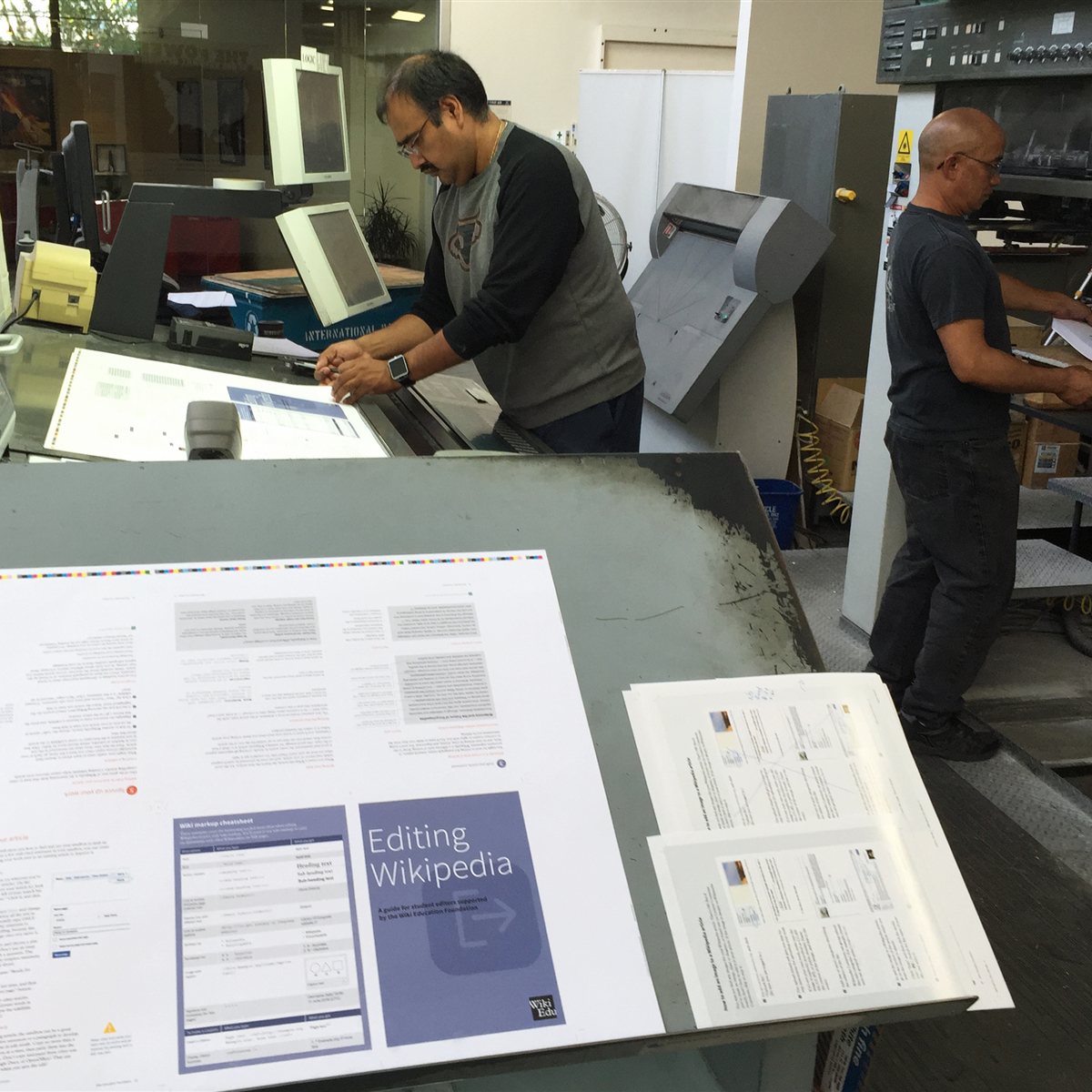
Illustration: a photograph of an offset-printing press check at a different print shop, not Gràfiques Manlleu. Photograph by David Peters, Wikimedia Commons, CC BY-SA 3.0. The cover is a square crop; the adapted image is distributed under CC BY-SA 3.0.