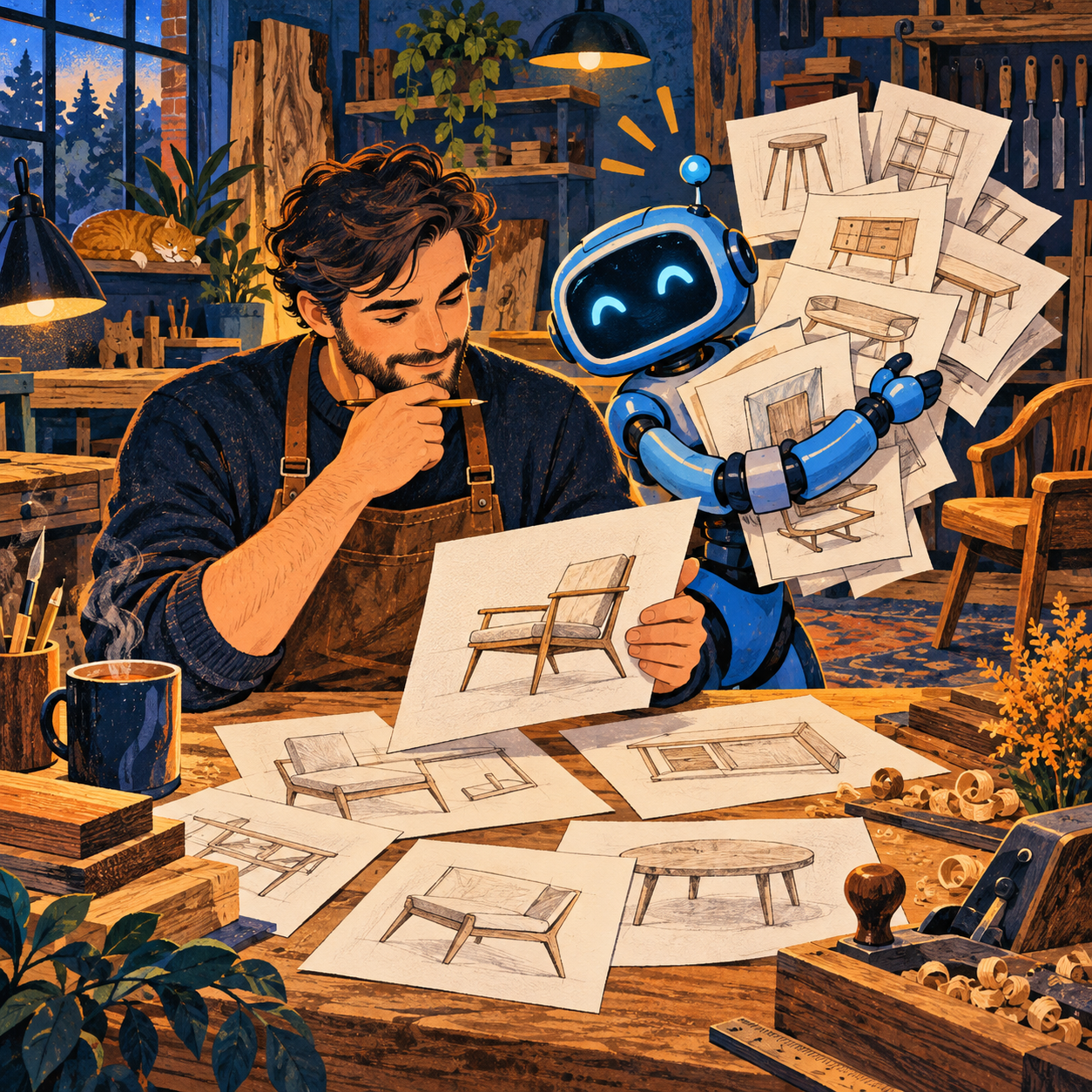
What happened in the workshop
Tischlerei Dein Freund, a custom joinery in Wedemark, Germany, makes furniture and interior solutions to order. Customer discussions call for more than measurements and a technical drawing: the workshop needs quick visual options showing how an idea might look before anything is built. It had already used the cloud service Midjourney. According to a case published by the European Digital Innovation Hubs (EDIH) Network, obtaining one satisfactory image often took 30–50 requests, each taking between 30 seconds and a minute. The bottleneck was the cycle of exploring options, not the craftsperson's work at the bench.
Under a “test before invest” programme, the DIH4AISec team installed Stable Diffusion locally and trained staff to use the AUTOMATIC1111 interface. The case also describes generating images from a simple sketch. The company gained a way to explore concepts rapidly in its own environment. This is a useful pattern for a small manufacturer: local AI does not pretend to “make the furniture”. It accelerates an intermediate language shared by the customer and the maker.
What the numbers do, and do not, mean
EDIH reports about three seconds to generate one image on the local system and says that, in the best cases, the time to obtain a satisfactory option fell by more than 95%. These are figures in a published project description, not an independent audit. The model and weight version, computer specification, resolution, number of generation steps, and whether the quality threshold was identical before and after are not disclosed. “Three seconds” cannot simply be transferred to any office PC.
Above all, the metric must not be swapped. Time to generate one picture is not time to deliver an approved project. Selection, dimensional corrections, material and construction checks, and a conversation with the customer remain. An image can promise furniture that looks wonderful only until someone tries to build it. The workshop benefits when visualisation speeds a discussion of a feasible design, not when an image counter sets a record.
The source provides no financial return-on-investment figure or verified increase in revenue. It reports faster visual iteration and staff learning to generate images locally. The published information does not establish payback for another business's hardware: EDIH supported implementation and training in this project, while no direct private investment by the joinery was reported.
Designing the workflow in your own business
A similar use case can suit furniture makers, interior design studios, small ateliers, and other businesses in which agreement on appearance occupies a substantial part of the sales cycle. Start with one order type, such as a made-to-measure cabinet. Gather real inputs you are allowed to use: photos of the room, a sketch, acceptable materials, dimensional constraints, and two or three examples of completed work. Do not upload customer photos and floor plans to someone else's service without the necessary contractual and internal permission.
Separate the stages:
- A sales manager or craftsperson records the requirements and constraints. The AI must not invent dimensions on the customer's behalf.
- The generator suggests a few visual directions. It can run locally; AUTOMATIC1111 is one possible interface, not a required architectural component.
- A person rejects infeasible combinations, checks proportions, and produces a working design in the team's usual design system.
- The customer sees an option clearly marked “concept, not a technical drawing”. After approval, the maker confirms construction and the quotation.
Local deployment makes sense when the company regularly produces variants, wants to control source materials, and can support a computer with a suitable accelerator. A cloud service may make more sense for occasional requests or without an IT owner. Locality alone guarantees neither confidentiality nor rights to specific model weights: check the licence of the chosen model, file permissions, and that the interface is not exposed to the internet without protection. Stable Diffusion names a family of models; it is not a blanket permission for every commercial use.
You do not need a CRM integration to start. A dedicated workstation, protected project folder, and a version-naming rule are enough. Integration becomes valuable when sketches, approvals, and quotations begin to disappear between chats and email. An order record should then retain the original brief, selected option, approval date, and responsible person. The generator should not be allowed to change a price or promised delivery date automatically.
Economics without the magic of “three seconds”
Calculate the total cost of one concept accepted by a customer, not the price of one image. Include brief preparation, repeat attempts, selection, corrections, approval, hardware depreciation, electricity, maintenance, and training. If the employee spends all the saved minutes checking the AI's fantasies, there may be no saving.
Here is an illustrative calculation, not a result from Tischlerei Dein Freund. Suppose a workshop prepares 40 concepts a month. Previously, iterations took 20 minutes of staff time per concept; after a pilot, they take 10 minutes, including selection and checking. The difference is 400 minutes, or 6 hours 40 minutes per month. At a fully loaded staff cost equivalent to RUB 1,200 per hour, that represents a notional RUB 8,000 monthly labour saving before hardware, implementation, and support costs. If checking after deployment adds another 10 minutes instead, the saving disappears. Use your own inputs for a purchase decision; these assumptions do not prove a local server will pay for itself.
Measure the commercial effect separately: how many customers approved a project faster, how many correction cycles were required, and how often an attractive idea had to be rejected as technically impossible. Do not credit the generator with better conversion until comparable orders have been compared. Rapid sketches may improve the customer conversation, but they do not replace the quality of the finished furniture or the maker's skill.
A two-week pilot
Select 10–20 recent orders of one type for which the final decisions are already known. Repeat the old process on some tasks and visual exploration with AI on others. Record not only generation time but time to an option the craftsperson accepts, iteration count, share of infeasible suggestions, time to customer approval, and cases where an image created a false expectation. Ideally, have the same specialist judge options using the same criteria; otherwise the comparison is unfair.
Set the minimum effect needed to justify spending before the pilot begins. For example, save at least a specified number of hours per month without increasing corrections or complaints. If the effect appears, document team instructions, source-data storage, and the final human check. If it does not, that is also a useful decision: do not buy a GPU just to display an impressive stopwatch. A robot can carry a stack of sketches; measuring the doorway and signing off on the quotation still belong to a person.
Sources: the EDIH case description, the workshop's official website, and the AUTOMATIC1111 interface repository. The project data are from a case published in February 2025. This article is a practical analysis, not an announcement of a new model release.