What actually happened
IBERICOGEN works in genetics and extensive Iberian pig farming in Spain. According to the European Digital Innovation Hubs Network's published account, it is a microenterprise with one to nine employees. In a project running from May to December 2025 with support from DIGIS3 and the AIR Institute, specialists first selected parameters worth collecting in the open dehesa pasture and then tested animal-mounted activity sensors. The prototype included data reception and storage and a viewing interface.
This is not a story about a neural network raising productivity in a week. Before the project, the company had no real-time digital animal monitoring. Its published assessment put digital readiness at 12% and automation and AI maturity at 8%. After the pilot, digital readiness rose to 29%, data governance from 52% to 60%, and overall digital maturity from 33% to 38%. Automation and AI maturity remained at 8%: the source does not claim that an operational AI system was deployed.
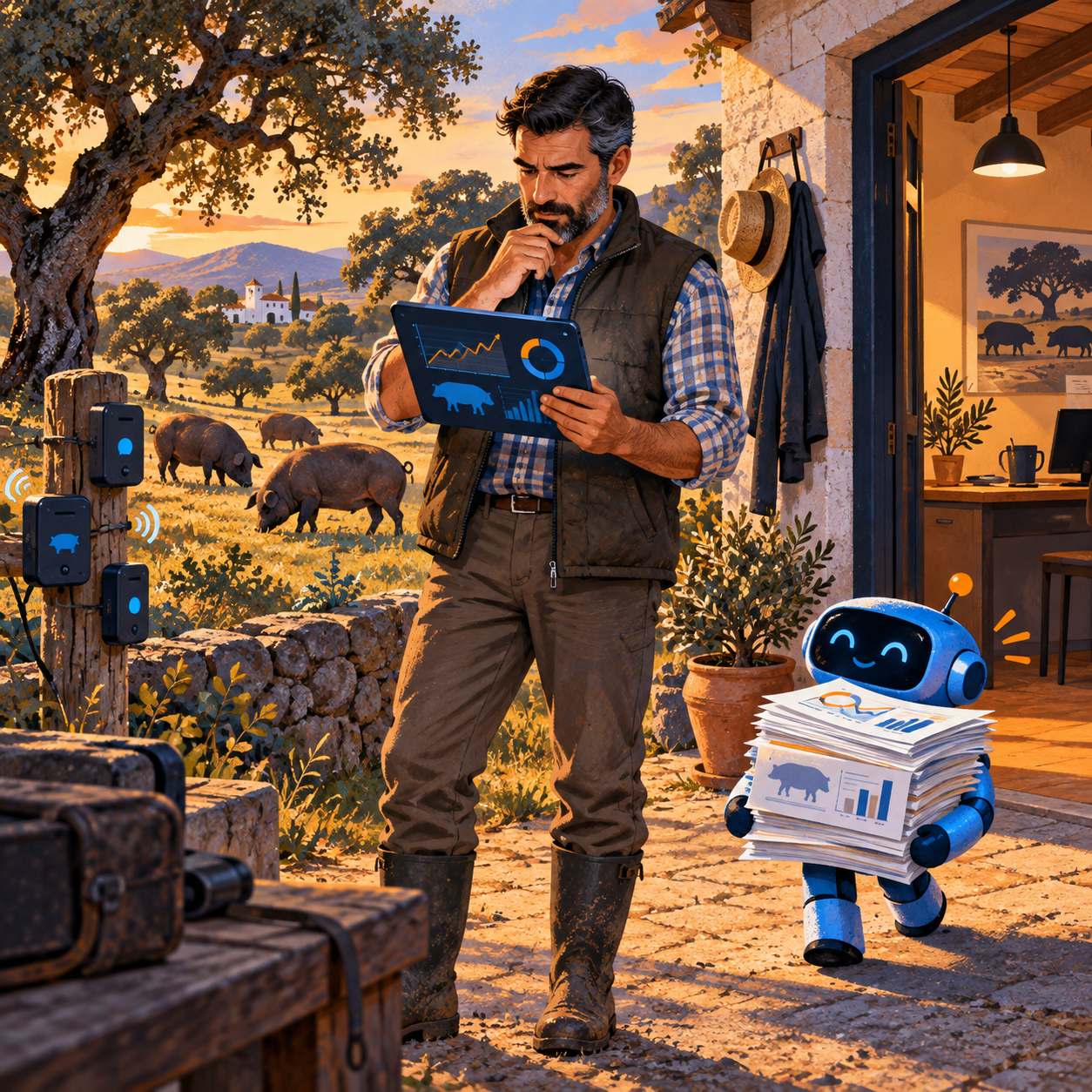
In the language of a project team, our little robot intern has brought an impressive pile of charts, while the manager is still checking whether every measurement belongs to the right animal and day. Without that, a prediction would be a confident guess, not useful assistance.
The business problem
On a farm, observing animal activity may help staff notice behavioral changes and compare them with feeding, herd condition, yield and product quality. But several links need to be tested between “a sensor detects movement” and “losses have fallen.” The business must establish which deviations call for action, who verifies them, how long response takes, and whether the operation's outcomes change.
The source describes the ability to collect movement and behavior data for subsequent analysis. It does not provide a verified percentage reduction in feed costs, increase in yield, or decline in illness. Those outcomes should not be attributed to the company. For an owner, that is the important boundary: a technically successful pilot and proven financial impact are different claims.
Similar lessons apply outside agriculture, including refrigeration, machinery, vehicles and warehouse areas. Each needs a reliable signal and a defined response process before a model. A model is appropriate only if an error or delayed decision is costly enough and there are data against which to compare current practice.
A minimal architecture without magic
The case suggests a practical pilot pattern; this is not a claim about every detail of IBERICOGEN's infrastructure:
- A sensor is attached to an asset and has a stable identifier. Before purchase, test accuracy, battery life, attachment conditions and whether it interferes with the animal or process.
- A communication link sends readings to a receiver. Where coverage is unreliable, buffering and timestamps matter. Test connectivity at the actual site, not on a vendor slide.
- Storage connects measurements with identifiers, time, device condition and operational events. Keep raw readings separate from cleaned indicators.
- A dashboard shows trends and gaps. A staff member checks whether an alert instead reflects a flat battery, faulty attachment or a lost connection.
- Only then do rules or a model generate warnings. A human remains responsible for interventions and results.
An external AI service is not inherently necessary. Where production data are sensitive, collection, storage and analysis can be kept on premises. Local deployment, however, cannot repair poor measurements. Retrieval-augmented generation and a language model might later help staff search procedures and explain validated signals; they do not replace sensor validation and should not issue unchecked commands to equipment.
Validate data before an “intelligent” forecast
Researchers at ILVO distinguish two checks for animal-based sensing systems. First, does the device measure the physical or behavioral output it purports to measure? Second, does that output actually indicate the welfare or condition ascribed to it? These are separate hypotheses. A convenient activity chart does not by itself establish an animal's health.
In a small pilot, specify a reference observation in advance: an expert's manual record, video annotation under agreed rules, or another reliable check. Include normal days, changing conditions, connectivity failures and different animals in the sample. Measure missing readings, false alerts and time from event to response separately. If success criteria appear only after the dashboard demonstration, a pilot may sound successful yet fail in daily operation.
Keep a simple decision log: which warning appeared, what was checked, what action followed and what happened. Without this, it is impossible to tell a useful signal from an attractive visualization. The robot intern can make the chart look excellent; its value is measured by human decisions and outcomes, not by its shade of blue.
Economics: a grant is not a return on investment
The published service value of the pilot was €30,000: €10,000 in consulting and €20,000 in testing. The hub says this was in-kind funding under PADIH, with no direct charge to the company for those services. It also mentions a separate €30,000 grant obtained. Neither the service value nor the grant proves an operational return, and neither can be copied into a Russian company's budget.
An owner should calculate total cost of ownership: devices and replacements, installation, connectivity, storage, integration, maintenance, reference-data labeling, staff time and alert review. Compare that with a measured baseline process, not an assumed “efficiency gain.”
An illustrative model only: suppose a pilot covers 100 assets, a device and installation cost 6,000 rubles per asset, and annual connectivity and maintenance cost 1,500 rubles per asset. The first year already costs 750,000 rubles before development and staff time: 100 × (6,000 + 1,500). These are assumptions, not IBERICOGEN data or a market quote. A scale-up decision requires avoided losses or time savings measured for the same assets and period, net of time spent checking false alerts.
A two-week management step
Select one area, one costly problem and one action triggered by a signal. Record the current event rate, losses and response time. With a limited group, test not “AI accuracy” but connectivity, data completeness, correct identifiers and whether staff can use the dashboard. Assign a data owner and someone who confirms alerts. After two weeks, decide whether there is enough foundation for a longer comparison; only then discuss a model, servers and scale.
IBERICOGEN's case is not a ready-made profit formula but a disciplined implementation sequence. Sensors made the process observable, and staff learned to work with the prototype, devices and data independently. The financial impact and AI use still need to be established. For a small business, that honest order is often cheaper than a sophisticated model with nothing reliable to measure.