Not a “digital farm,” but one season of observation
Hungarian farmer Gyöngyösi Csaba operates relatively small plots: 7.45 hectares of grain maize, 5.82 hectares of sunflower, and 4.51 hectares of stubble. For a business of this size, buying the wrong equipment is painful, while a dedicated analytics team is unrealistic. Connectivity in the area is unreliable and digital adoption is low—the kind of environment where an impressive cloud service can quickly become an expensive screen with no current data.
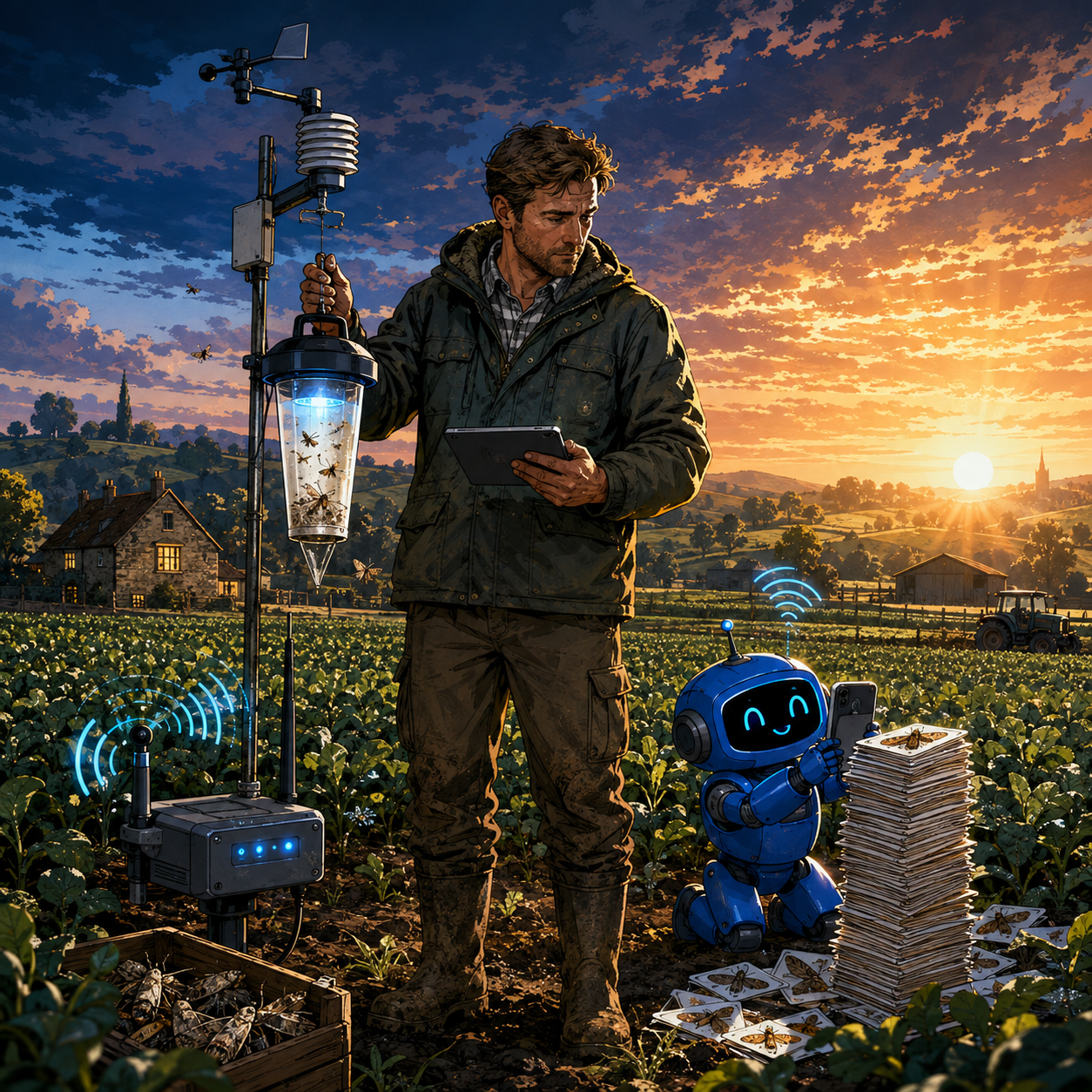
The Agricultural European Digital Innovation Hub (AEDIH) structured the pilot around a sensible principle: let the farm test equipment through a real growing season before deciding whether to buy it. The kit included weather stations, separate air, soil, and leaf sensors, a LoRa gateway, a data collection server, and a camera-equipped smart insect trap with automated recognition.
The case is valuable precisely because it does not promise autonomous agronomy. It tests whether data can reduce uncertainty in specific decisions: whether a trip to the field is necessary, whether conditions permit an operation, whether a trap needs inspection, and whether an algorithmic alert matches the situation on the ground.
What was assembled in the field
The European Digital Innovation Hubs Network describes a heterogeneous but practical stack. Dragino and SenseCAP sensors measured leaf and soil moisture, temperature, and air humidity. Communications used a LoRa gateway, a 1NCE data card, and a ChirpStack server. Data was displayed through a web interface built on a conventional server stack.
Weather stations from different product classes were tested in parallel. A consumer Sencor SWS12500 measured wind, pressure, temperature, humidity, precipitation, light, and ultraviolet radiation and transmitted readings every minute. A professional Sencrop Raincrop provided a more specialised service but required a subscription. The important point is not which product “won.” The method is to compare required signals, interface openness, and the full cost of access to data instead of relying on the word “professional” in a catalogue.
A ScoutLabs trap was another component. Its camera photographs captured insects, an algorithm attempts to identify pests, and the service issues notifications. AEDIH presents it as a tool for automated monitoring and forecasting flight dynamics. The claim of up to 80% labour savings comes from the vendor; the published account of this particular farm does not provide an independent measurement of that saving, increased yield, or reduced chemical use.
That boundary matters to a manager. A functioning sensor does not yet prove financial value. It creates a measurable loop in which value can be tested.
Why a local gateway is better than permanent faith in the internet
When connectivity is unreliable, the process cannot assume that every packet will immediately reach a cloud service. A resilient design separates collection, storage, and decision-making:
- sensors send short messages to a local LoRa gateway;
- the gateway buffers data when the external connection fails;
- the server ingests messages after reconnection while preserving the actual measurement time;
- alert rules use fresh observations and do not present delayed packets as current conditions;
- the agronomist sees not only the value but also data age, battery state, and the last contact with the device.
For a small farm, a local layer does not have to mean a GPU rack. Telemetry needs an inexpensive gateway and server. Image recognition may run on the device, on a shared local server, or at the vendor. The choice depends on image volume, link quality, data requirements, and the ability to update the model.
The essential feature is graceful degradation. If the algorithm or the connection is unavailable, the physical trap and manual inspection must remain usable. AI increases observation frequency; it does not abolish the basic process.
Where recognition ends and a decision begins
An independent field study of an automated codling moth trap shows why a notification should not become an immediate treatment command. In laboratory validation, its YOLOv8 model achieved precision of 0.77 and recall of 0.83. During a 42-day field deployment, performance fell to roughly 0.65 precision and 0.63 recall. The authors associate the decline with limited training-set diversity, backgrounds, and non-target insects.
This is not an evaluation of ScoutLabs and it is not a result from the Hungarian pilot. It is a separate field study that provides a useful reference for the technology class. It highlights two operational risks:
- a false positive can send an employee on an unnecessary trip or encourage an unnecessary treatment;
- a missed pest can create false confidence.
A sound interface therefore shows the image, model confidence, and event history while leaving the critical decision to a person. At the beginning, the algorithm should function as a queue filter: it raises suspicious images, an agronomist confirms the class, and the correction is retained for later model evaluation.
Calculating economics without inventing yield gains
A seasonal pilot can compare two processes for the same type of field: calendar-based manual rounds and rounds driven by verified signals. There is no need to attribute protected yield to AI in advance. Start with observable quantities:
- trips to traps and sensors;
- staff time spent travelling, inspecting, and transcribing records;
- connectivity, subscription, gateway, sensor, and maintenance costs;
- the share of alerts confirmed by a person;
- the share of real events detected by the system;
- time from event appearance to confirmation;
- downtime caused by depleted batteries, dirty cameras, or lost connectivity.
A modelled cost per accepted signal equals seasonal equipment, connectivity, subscription, installation, and review expenses divided by the number of confirmed notifications that actually changed a route or decision. The value of an avoided trip includes fuel, staff time, and equipment downtime, but only trips that truly did not take place should be counted.
If the system sends hundreds of photographs while the agronomist still visits every point on the old schedule, digitisation has not yet created operating savings. It may still provide an archive and training value, but that is a different outcome and should have a different budget.
A minimum viable pilot architecture
A farm or agricultural service provider can use a narrow six-part design:
1. One crop, one plot, and one pest with a known intervention threshold.
2. A conventional control trap beside the digital trap to preserve a reference.
3. Weather data and a leaf- or soil-moisture sensor only when those signals affect the decision.
4. A gateway with buffering, connectivity logs, and explicit data-age indicators.
5. An image queue reviewed by an agronomist, not an automatic spraying command.
6. A weekly report covering alert accuracy, missed events, avoided trips, cost, and downtime.
Each record should include the plot, device and trap identifiers, capture time, model version, and expert decision. Without this lineage, the business cannot distinguish a model improvement from a change in weather, camera placement, or lure.
Permissions should also be separated. A sensor may transmit telemetry, an operator may confirm an event, and a manager may change thresholds and notification policy. If an external cloud is used, the contract should explicitly cover export of original images, retention periods, use of farm data for model training, and retrieval of history when changing vendors.
What can break the pilot
The most common mistake is to evaluate only algorithmic accuracy. In practice, physics can undermine the outcome: camera angle, dirt on the lens, lighting, lure, trap colour and entrance size, battery condition, and non-target insects. The independent codling moth study showed that trap design and field conditions matter as much as the model.
The second mistake is deploying many devices before creating a maintenance process. Every sensor needs an owner, an inspection schedule, and available consumables. Otherwise, the dashboard gradually fills not with crop risks but with flat batteries.
The third mistake is treating notification and recommendation as the same thing. “The image probably contains a pest” does not mean “treat the field.” Population thresholds, crop stage, weather forecasts, product rules, and the agronomist’s accountability still sit between those statements.
The next step for a small farm
Do not begin by purchasing a network of devices. Select one costly inspection route or one risk currently checked by hand. For one season, place a digital trap beside a control trap, add only the weather signals required for the decision, and define metrics before installation.
After eight to twelve weeks, the scale-up decision should answer four questions: how many confirmed events the system detected, how many it missed, how many trips actually changed, and how much each useful signal cost. If connectivity is unstable, test buffering and recovery from an outage separately.
The Hungarian case is not valuable because it proves a return on investment—the publication does not claim one. Its practical lesson is that a small business can adopt AI more safely when equipment is available for a full-season test, data remains accessible, and the technology is wrapped in an advisory service. A smart trap should first prove that it helps a person see the field in time. Everything else belongs to the next harvest.