What Globant announced
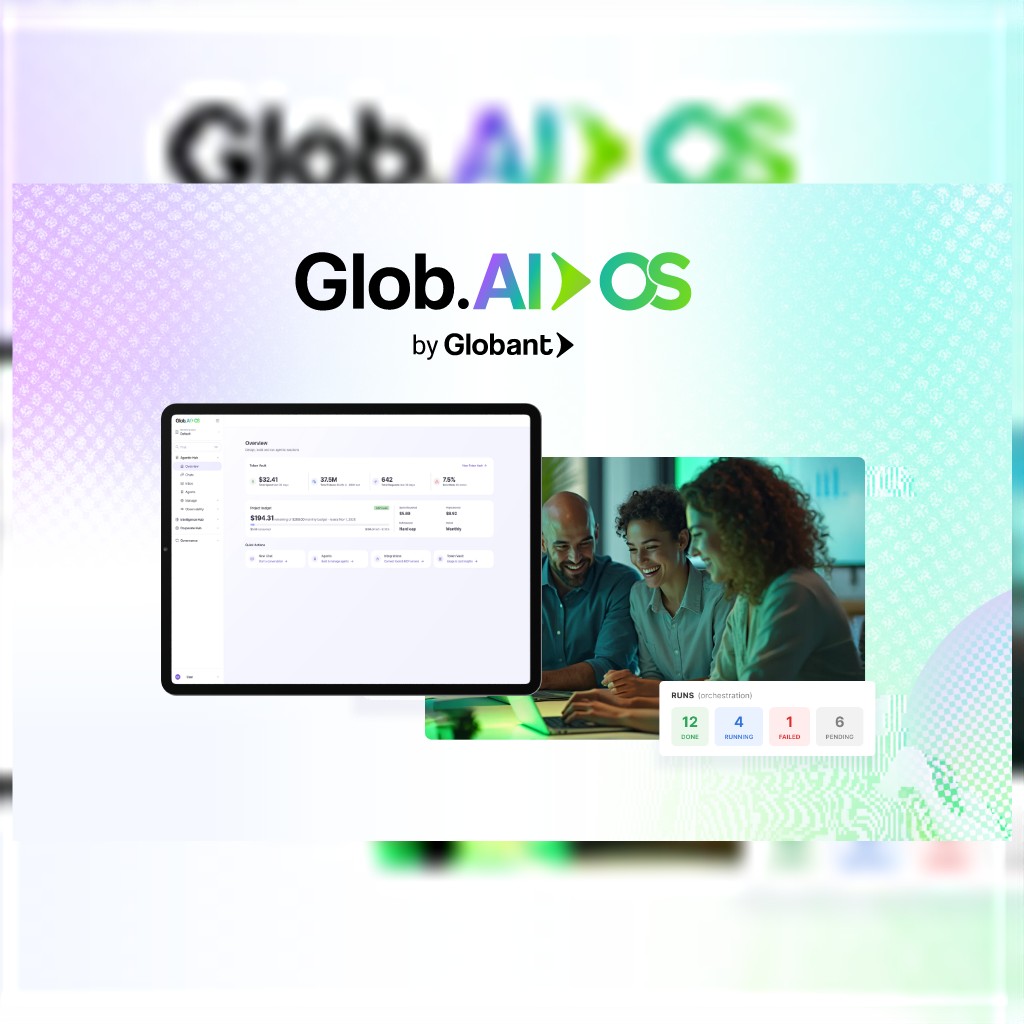
On October 27, 2026, Globant expanded its Glob.AI platform with Glob.AI OS. The company says this governance layer connects more than 320 open and closed models from 25+ providers, links them to enterprise data and systems, and supports the creation and runtime management of agents.
The description names four components: routing requests across models; connecting corporate data and identity; testing and orchestrating agents; and managing permissions, budgets, cost attribution, and audit logs. SaaS and deployment in a customer's cloud are offered as options. The product was opened for early access.
This is a vendor description, not an independently verified deployment outcome. The press release also includes Globant's claims about project metrics without independent validation; they are not treated here as a buyer forecast.
Practical relevance for Russian businesses
The announcement does not mean that a small business needs another universal AI platform or that the product is already available in Russia. Globant has not disclosed pricing or regional applicability. A more useful approach is to treat the announcement as a checklist when evaluating any AI governance layer:
- Can models and tools be restricted by user role?
- Are limits, costs, and automation owners visible?
- Are requests and actions logged at a level compatible with the data policy?
- Can agents connect to business systems through narrow permissions?
- What happens to identity, logs, and data in SaaS versus customer-cloud deployment?
For a small team, these requirements may be covered more simply by an API gateway, logging, an approval queue, and existing identity management. A platform is worth buying only if it lowers operating cost compared with a home-grown set of components and passes an information-security review.
How to evaluate a solution like this
Start with one process and document the current workflow: source systems, participants, error frequency, task time, and the impact of an incorrect action. Then ask for a demonstration of three cases: a user without the required role, a breached spending limit, and an agent attempting to access restricted data.
Before a pilot, request the commercial model, regional availability, log-retention design, supported integrations, cloud boundaries, and data-export options. Also clarify portability of configuration and the cost of leaving the platform.
Limitations
The model and provider counts are Globant's statements as of the release date; the integration list and feature availability must be confirmed in a specific offer. A customer-cloud option does not replace architectural or legal review, and early access is not the same as a production-ready service.
Bottom line
Glob.AI OS does not yet give Russian SMBs a verified “connect it and it works” solution. Its useful role today is as a checklist for managing permissions, budgets, data, and agent actions, to compare with existing infrastructure and the real cost of a pilot.