What happened at the Japanese microbusiness
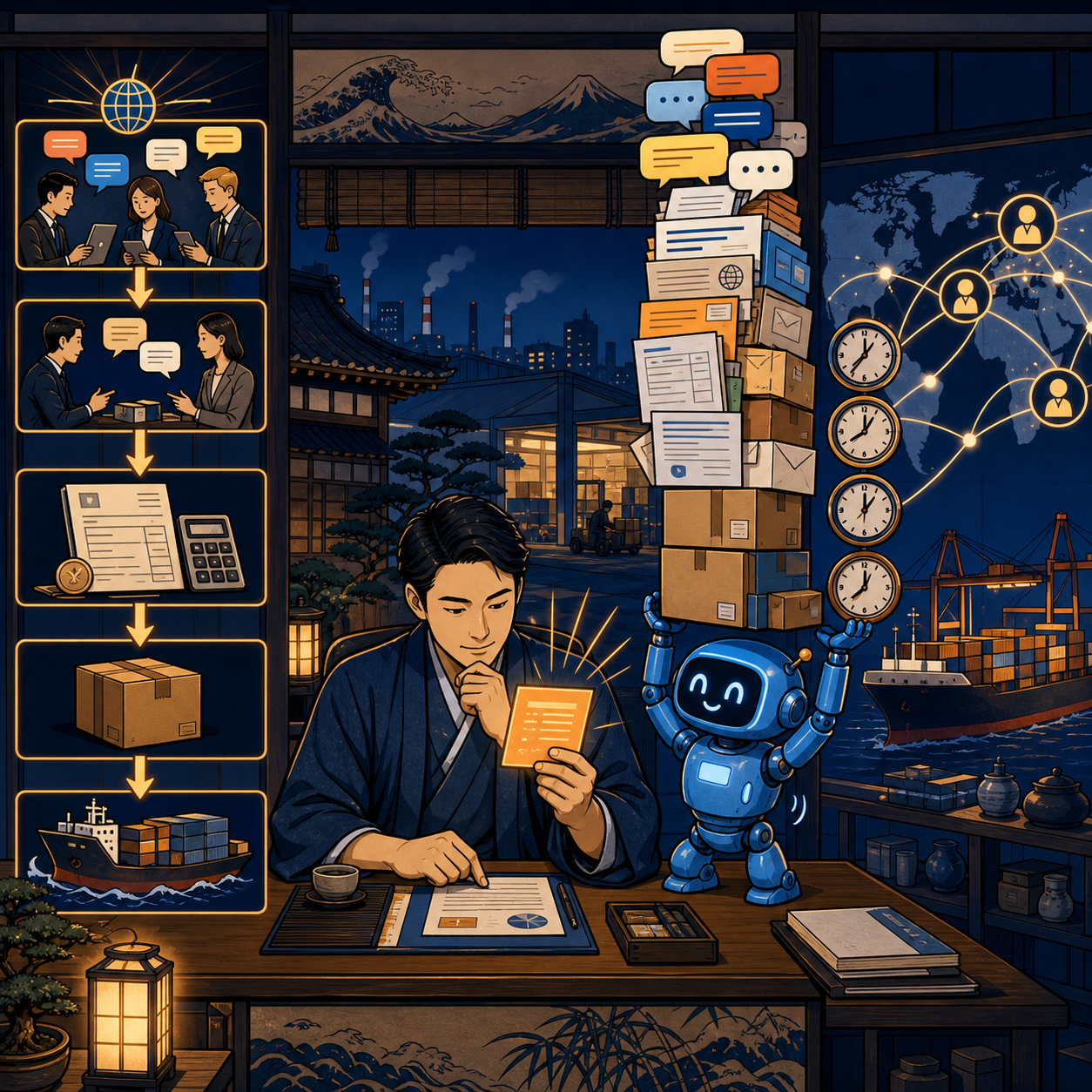
The official G7 blueprint for AI adoption by small and medium-sized enterprises describes a Tokyo microbusiness that connects local manufacturers with overseas customers. Its process faced three constraints familiar to many B2B firms: a small team, language barriers, and delayed responses across time zones.
The company built custom AI agents for three connected jobs: answering questions, supporting project negotiations, and powering multilingual chat. According to the case, sellers reported higher revenues and time saved when accepting inquiries, invoicing, and organising shipments. Buyers reported faster responses, shorter negotiation cycles, and less time spent on market insights and product development.
This is useful evidence, but not a controlled study. The company is anonymous, and neither the G7 nor the OECD provides sample size, baseline cycle time, absolute revenue, development cost, or an error rate. The statements about growth and savings should therefore be treated as participant-reported direction, not a transferable ROI benchmark.
The practical lesson is not that “an agent can sell on its own.” The microbusiness targeted a bottleneck where the same context must move across email, translation, commercial discussion, invoicing, and shipment. Value appears when a system reduces those handoffs without gaining authority to change prices, terms, or payment details.
The process before automation
In a small wholesale company, an inquiry often arrives as unstructured text. A manager must identify the product, check specifications and availability, clarify currency and delivery terms, translate the answer, approve exceptions, move data into a CRM or spreadsheet, prepare an invoice, and hand the order to logistics.
Each transition creates waiting time and error risk. A translator does not know the current price list. The manager searches for the same specification again. Conversation data is copied manually into the ERP. A buyer's overnight message waits until the next working day. As volume grows, the company either hires coordinators or begins losing inquiries.
An AI agent is useful here as a coordinator of drafts and checks. It can structure an inquiry, retrieve permitted data, propose an answer in the buyer's language, and create tasks in business systems. Decisions about discounts, deadlines, substitutions, and payments remain with an employee.
A repeatable architecture
A practical system for this use case has seven layers.
1. **Unified intake.** Email, website forms, and messages enter one queue. The system preserves the original text, attachments, channel, sender, and timestamp.
2. **Inquiry parsing.** A model extracts language, company, product, quantity, geography, deadline, and missing fields. The result is written to a strict schema rather than left as free text.
3. **Customer and product checks.** Deterministic code matches the customer against the CRM, the item against the catalogue, and inventory and prices against the ERP. When a match is ambiguous, the agent asks a question instead of guessing.
4. **RAG over authorised data.** Retrieval returns product cards, export rules, response templates, and approved customer terms. The draft includes references to document versions.
5. **Multilingual draft.** The model creates an answer in the buyer's language while showing the employee a Russian version, the data used, and fields that need confirmation.
6. **Human gates.** A manager approves price, discount, delivery date, payment details, contractual exceptions, and product substitutions. A separate service sends a message or creates a document only after confirmation.
7. **Audit and feedback.** The system records the inquiry, retrieved sources, model version, proposal, employee corrections, executed action, and duration of every stage.
This design does not require a universal autonomous salesperson. A pilot needs an orchestrator, a model for extraction and drafting, retrieval over reference data, CRM and ERP connectors, and an approval interface. The fewer permissions the first version has, the faster the business can test value without expensive risk.
Data and integrations required
The minimum data set includes:
- an SKU catalogue with units of measure, aliases, and language mappings;
- current prices, currencies, stock, and minimum order quantities;
- customer records, permitted markets, and negotiated terms;
- delivery, payment, return, and export rules;
- inquiry, response, correction, and rejection history;
- invoice templates and mandatory fields;
- responsible employees and approval levels.
Separate read integrations from action integrations. The agent may read the catalogue and order status through a service account, while writing a discount or sending an invoice must use a controlled method. Attachments need malware scanning, file-type restrictions, and an isolated parser: a customer's email is not a trusted instruction to the system.
If operational data lives in spreadsheets without stable identifiers, reference-data cleanup comes first. Confusing a “set” with a “unit,” or matching two products with similar names, costs more than any tokens saved.
Where a local deployment fits
A local model or hybrid architecture is justified when correspondence contains personal data, purchase prices, discounts, banking details, contracts, or non-public product specifications. Extraction of details, price-list retrieval, and drafting in Russian can remain inside the company. If an external API is required, only de-identified text may be sent for translation or style polishing.
A low-volume business does not necessarily need to buy a GPU on day one. A pilot can run on a protected rented server or existing hardware while measuring latency and cost. Local deployment does not remove the need for access controls, backups, audit logs, and translation-quality checks.
RAG is appropriate for changing facts: price, stock, technical specifications, and customer terms. Fine-tuning a model on those facts is usually inferior to retrieving the current source. Training or adapting a model may help with stable terminology and document formats, but not a price list that changes every week.
Risks and limitations
The first risk is a confident mistranslation of a commercial term. Employees should see both language versions, the source passage, and the glossary. Critical phrases benefit from back translation and deterministic checks of currencies, numbers, units, and dates.
The second risk is an autonomous promise. The agent must not change a price, guarantee stock, accept contractual liability, or send payment details on its own. Those fields come only from systems of record and require confirmation.
The third risk is an instruction in an email or attachment that attempts to change agent behaviour. Customer content is data. System policy, tools, and permissions are defined separately, and model output is never executed as a command.
The fourth risk is invisible degradation. The catalogue changes, a new employee corrects drafts differently, or a new market and language appear. The system needs sample audits, correction statistics, and an automatic stop when errors rise.
Finally, the published case does not prove that a custom agent is profitable for every microbusiness. At low inquiry volume, standard templates, translation, and a single manager screen may be cheaper. An agent becomes justified when manual handoffs recur often enough to create measurable sales delays.
Calculating a pilot without invented ROI
Before launch, record four baseline metrics: inbound inquiry volume, median time to the first substantive response, manager labour per inquiry, and the share of errors or returns caused by incorrect data.
Consider a modelled example. Six hundred inquiries per month require 15 minutes of coordination each, or 150 hours. If an AI workflow reduces active work to seven minutes while 20% of inquiries need five extra minutes of review, labour becomes 80 hours. The potential capacity released is 70 hours per month.
This is not a result from the G7 company; it is an illustration built on assumptions. The cost of those 70 hours must be reduced by infrastructure, support, quality control, and integration amortisation. The business must then account separately for the cost and probability of a material mistake. If one incorrect invoice can consume a month of savings, automatic invoice sending does not belong in the pilot.
Set explicit gates for evaluation:
- at least a 30% reduction in median first-response time;
- at least a 25% reduction in manager active time;
- no more than 2% correction of critical fields after approval;
- zero autonomously sent discounts, payment details, or contractual promises;
- a complete audit record for every action;
- manual fallback when the model or integration is unavailable.
Each company should choose thresholds for its own economics. The important point is not the exact percentage but a stop rule established before the pilot.
A four-week pilot plan
**Week 1.** Select one channel and one product segment. Map the path from inquiry to invoice, measure baseline time, and collect 100–200 de-identified examples.
**Week 2.** Connect read-only access to the catalogue and CRM. The agent extracts fields and prepares a bilingual draft but sends nothing.
**Week 3.** Run shadow mode on live traffic. Managers compare drafts with their own responses and label errors and correction reasons.
**Week 4.** Permit sending only after explicit approval. Measure cycle time, corrections, lost inquiries, infrastructure cost, and employee workload.
Scale a workflow that passes the gates, not “the agent” as a vague product. Drafting an invoice or creating a shipment task may come next, but every new action receives separate permissions, tests, and an accountable owner.
Management takeaway
The G7 case illustrates an approach relevant to Russian wholesale businesses: automate the movement of context between channels, languages, and systems rather than the negotiating decision. Start with one flow and measure response time, labour, and critical corrections.
Do not buy the promise of an autonomous sales department. First allow the agent to read, retrieve, and draft; a person confirms prices, terms, invoices, and shipments. Vnutrik will gladly support every time zone at once—management only needs to ensure he does not start setting exchange rates too.