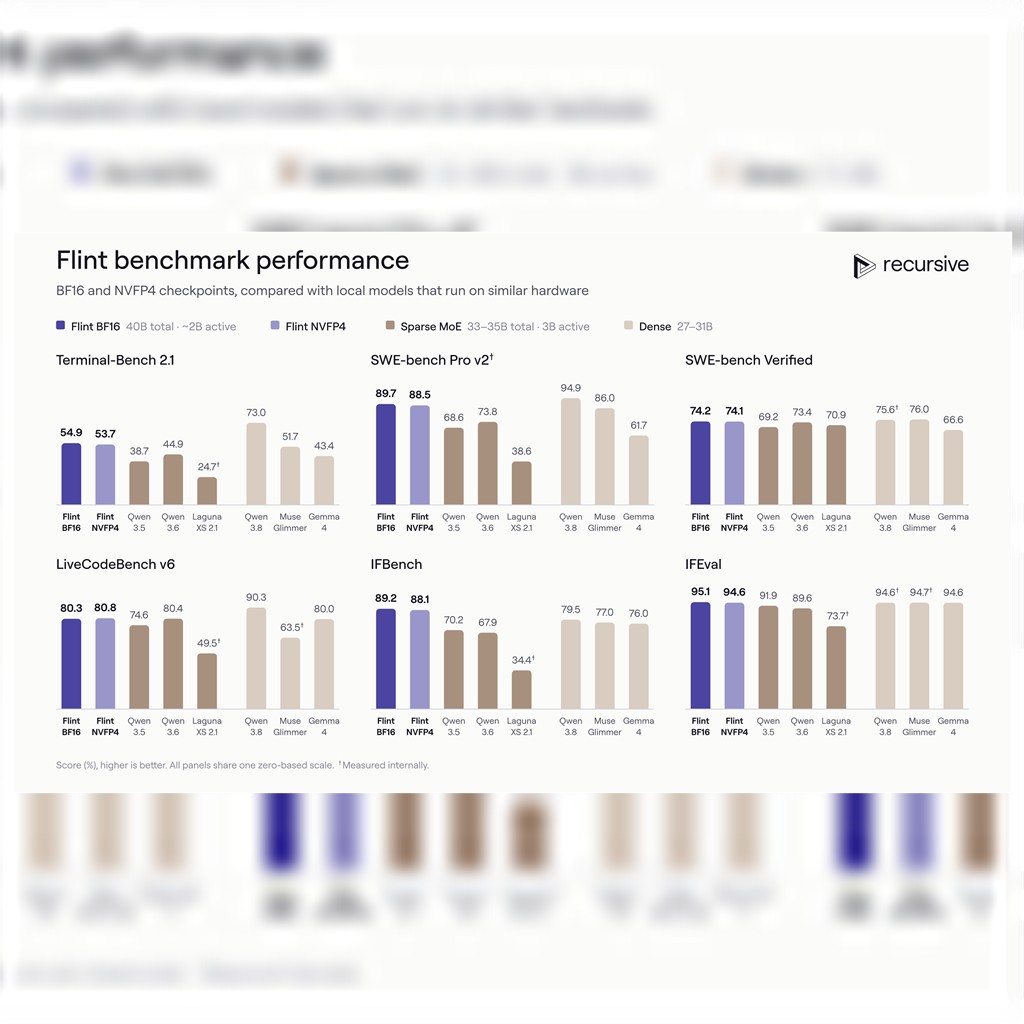
What Recursive released
The Flint model card describes it as a mixture-of-experts model for coding agents, intended to explore repositories, fix bugs, implement features, and write tests. The weights are published on Hugging Face under Apache 2.0. The repository includes the BF16 checkpoint, configuration, tokenizer, chat template, and an SGLang serving kit.
The model has 39.8 billion parameters, with about 2.5 billion active per token. Its configured context is 262,144 tokens, including prompt and generated output. The developer lists about 80 GB for the BF16 download and recommends one B300 or H200 accelerator per replica. That does not mean any GPU with that amount of memory is sufficient: the runtime, KV cache, prompt length, and concurrency all matter.
What this means for a small team
For a Russian business, the practical question is not whether to move the entire development workflow to a new model immediately. Flint can be tested in an isolated environment on a narrow set of tasks: explaining unfamiliar code, drafting tests, locating a likely bug, or preparing a small change. Open weights and the license make an independent evaluation possible, but do not remove hardware, maintenance, or review requirements.
A small test of a quantized version on an RTX 5090, mentioned in the original post, completed 12 of 18 runs successfully; mistakes appeared in line counting and a complex project. This is a small-sample observation, not an independent industry benchmark or a prediction for another setup. The model-card scores also use specific developer evaluation protocols and do not predict performance on a private repository.
How to run a constrained pilot
- Select 20–30 de-identified tasks from your engineering backlog and define expected outcomes before running the model.
- Compare Flint with your current tool on the same code revision, token budget, and time limit.
- Measure not only answer quality, but engineer review time, accepted-change rate, test failures, latency, and GPU usage.
- Keep command execution, branch changes, and merges under developer control.
A first decision can be made with one server or rented test node, an isolated repository copy, and a test suite. Calculate cost per completed task rather than per token: include the accelerator, power or rental, environment maintenance, and engineering validation time.
Limitations
Apache 2.0 applies to the released weights; terms and data handling for third-party hosted APIs must be checked separately. A large context is a configuration limit, not a guarantee of uniform accuracy over long inputs. Results vary by checkpoint precision and inference stack. Code and tool calls remain probabilistic: use tests, human review, and standard permission boundaries before applying them.
For a team without access to a B300 or H200, the full BF16 scenario may be disproportionate to the task. Quantization reduces requirements but can change quality and speed, so measure it on the target hardware.
Bottom line
Flint is worth a controlled self-hosted evaluation as a coding checkpoint, not as a “free local developer.” Start with a narrow task, a fixed test set, and cost per accepted change. Decide whether to buy hardware only after comparing it with the current workflow.