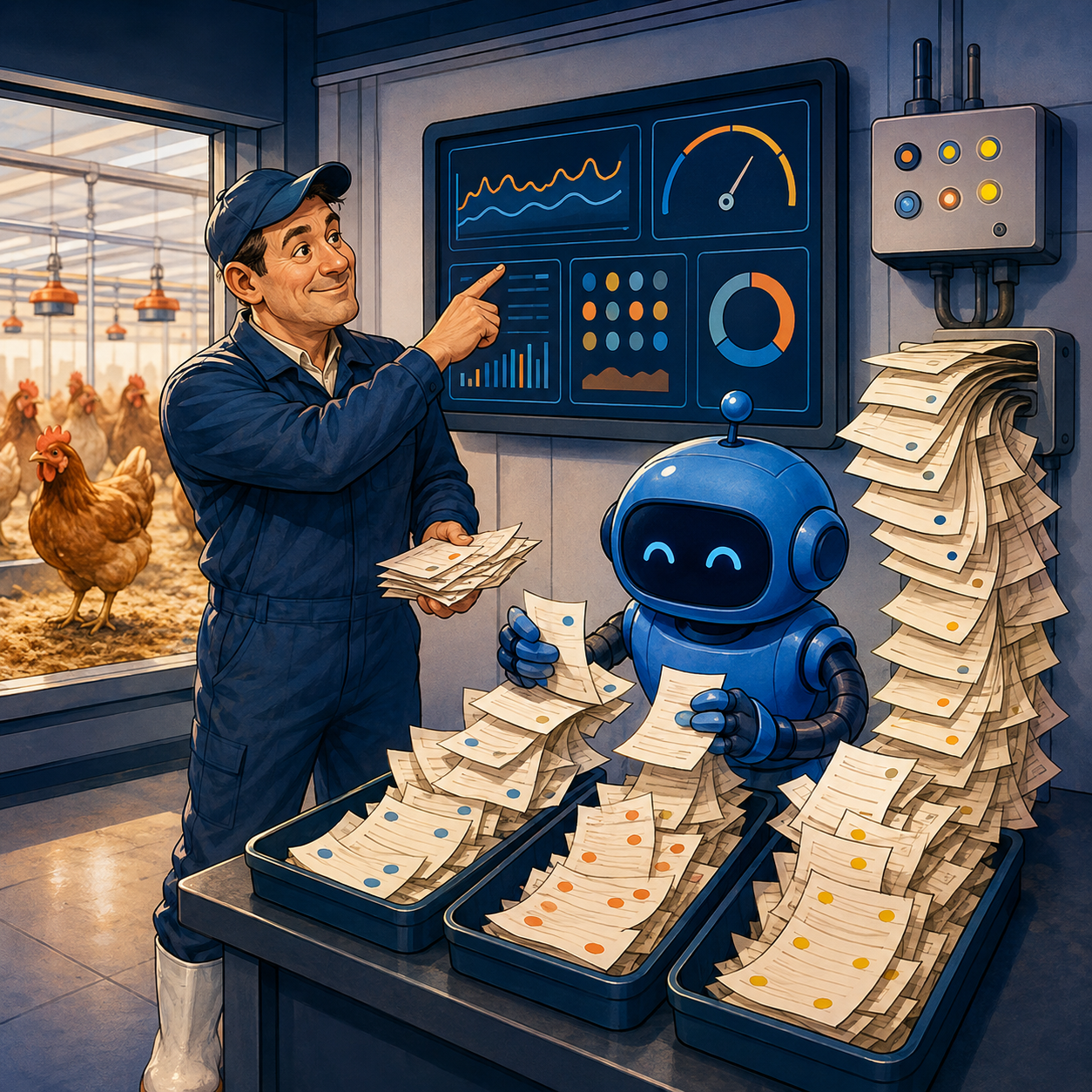
Norwegian startup Faunus Hub began its poultry assistant where data is often lost: workers’ observations. An EDIH case describes how free-form descriptions are combined with sensor and production-system records.
The same gap exists in a warehouse, service desk, workshop, or field-maintenance team: an employee notices a deviation, but the signal remains in a conversation or memory. AI is useful when it translates the note into a verifiable record. A person still decides.
What the case confirms
Faunus Hub is a Norwegian microbusiness founded in January 2025. The EDIH publication dated 9 June 2026 identifies it as a company with one to nine employees and paying pilot customers in Norway and Denmark. The startup received training, investment support, and access to Test Before Invest services through EDIH Oceanopolis and the Mechatronics Innovation Lab.
During product validation, the team found a practical constraint: computers were inconvenient for poultry-house workers, their hands had to remain free, and bringing devices into the building could conflict with biosecurity rules. The product therefore accepts observations in natural form, transforms them into data, and combines them with sensor and production-system information.
The public Faunus Hub listing on Google Play describes a more concrete operating loop: quick logging of observations and tasks, one view across houses and flocks, daily priorities, task-resolution tracking, weekly summaries, and an action log. These are developer-supplied product claims. They confirm the product direction but do not by themselves prove customer economics.
Independent Norwegian publication Shifter confirmed the company’s existence, the founders’ domain experience, and the spring 2026 investment-competition win, but not measured production impact.
What the case does not yet prove
Paying pilots, investment, and activity in more than one market are not the same as demonstrated payback for a farm.
The public material contains no comparable before-and-after figures for reporting time, observation completeness, response time, feed use, illness, mortality, or production yield. It does not identify the language model, its deployment location, field-extraction accuracy, or the review procedure. The capture channel is also unspecified: natural language could arrive as typed text, speech, or another interface.
Faunus Hub documents a useful product pattern and early market validation. It is not possible to claim that AI has already improved biological outcomes by a particular percentage; a pilot must measure an operational outcome.
Where the value comes from
Production sensors record temperature, humidity, pressure, energy use, and line speed well. They rarely explain context. A worker notices an unusual smell, noise, wet bedding, damaged packaging, unexpected machine behaviour, or a material change. If that observation never enters a system, analytics sees only half of the situation.
A free-form note is convenient for a person but difficult to calculate with. It may omit the time, asset, severity, or action taken. One employee writes “it feels hot,” another “temperature is above normal,” and a third “check ventilation.” AI can normalize these variants into one schema and ask a follow-up question when essential information is missing.
The value is not text generation. It is closing the gap between an observation and a manageable event:
- the fact is captured during work or immediately afterwards;
- the record receives an asset, time, category, and confidence level;
- the system aligns it with telemetry and history;
- the responsible person sees the priority and the original evidence;
- the selected action and outcome return to the log.
An architecture for another small business
The public case does not disclose Faunus Hub’s internal architecture. The following is a recommended design for a similar project, not a claim about the startup’s implementation.
1. **Controlled capture.** A worker describes an event through an approved channel: a terminal outside the clean zone, an app, a radio workflow with transcription, or a corporate form. Operations and security select the channel together.
2. **Structured extraction.** A model extracts the asset, time, category, severity, and uncertainty. If speech is used, a separate ASR component transcribes it first.
3. **Deterministic validation.** Master data checks the asset, flock, and units. Missing required fields trigger clarification rather than a model guess.
4. **Enrichment.** A service attaches telemetry, shift history, maintenance records, and open tasks. Temporal coincidence is not proof of causation.
5. **Rules and analytics.** Threshold rules or a specialist classifier creates the signal; the language model only explains context.
6. **Human decision.** A specialist confirms the action, with two-step approval for high-risk scenarios.
7. **Outcome log.** The original and structured records, model version, human decision, completed work, and verified result are stored.
The minimum data model
Do not start with a prompt. Agree on the event record: site and asset, batch, time, author and role, original description, category, measured features, severity, confidence, attachments, approved action, owner, and verification result.
Every automatically populated field should have provenance and confidence. The source text must not be replaced by a polished paraphrase; it is required for error analysis. Sensitive processes should also store model and schema versions plus the request identifier.
Does the model need to be local?
The public sources do not say whether Faunus Hub runs locally or in the cloud. In an analogous Russian deployment, a local model is justified when connectivity is unreliable, production data cannot be sent to an external provider, or predictable latency is required. Extracting a short record into JSON often does not require the largest model. Schema stability, a Russian domain vocabulary, and abstention under uncertainty matter more.
A hosted API remains reasonable for a pilot when the data scope, processing region, retention period, and prohibition on training with customer content have been agreed legally. A hybrid design can keep identifiers and telemetry on premises while sending only anonymized text outside.
Make the decision after an identical shadow test. Compare local and hosted models on one dataset using required-field accuracy, latency, cost per accepted record, and the fraction of cases routed to a person.
How to evaluate quality
“The answer looks right” is a dangerous metric. Prepare 200–500 real anonymized observations and label them with a process expert. Use different thresholds for a wrong routine category and a missed risk signal.
Measure separately:
- completeness of required fields;
- accuracy of asset and time identifiers;
- dangerous false-negative rate;
- correct abstention and clarification rate;
- time from observation to approved record;
- percentage accepted without manual correction;
- variation across shifts and sites.
Set a threshold for each field. A routine task may be created at high confidence, while animal-health, human-safety, or line-shutdown signals always require specialist confirmation.
Integrations and duplicate protection
The system becomes useful when it connects to sensor time series, asset master data, task management, and production logs. ERP integration is not required on day one: a pilot can use one asset, one observation type, and one owner queue.
Each record needs a stable identifier. A retry after connectivity failure must update the event rather than create a second emergency task. Photos and audio should be stored separately with checksums and retention limits. Access is role-based, and bulk exports are logged.
If RAG is added for operating instructions, it should return a citation and document version. In critical scenarios, the model prepares guidance rather than sending commands to equipment.
Pilot economics
Do not treat the number of parsed notes as the success metric. The basic unit is an accepted record that helped someone make or verify an action.
Before the pilot, measure:
- minutes needed to capture and transfer one observation;
- the share of notes that are incomplete or lost;
- time spent by a manager compiling a shift summary;
- number of duplicate tasks;
- time to close the “observe, decide, verify” loop.
Afterwards, add infrastructure, speech recognition, integration, quality-control, and correction costs. A simple formula is enough:
`Cost per accepted record = (inference + integration + operations + review) / accepted records`
Do not import Faunus Hub’s fundraising results into customer ROI. Raised capital confirms investor interest, not savings at a particular farm.
A four-week plan
In week one, select one observation type and one site, then map the current data path and cost of a missed signal. In week two, build a gold dataset, agree on the schema, and run only in shadow mode. In week three, give 5–10 employees a convenient interface while preserving the old process, and measure corrections, omissions, and latency. In week four, allow only low-risk task creation, review errors with the process specialist, and calculate cost per accepted record.
What a manager should take away
Faunus Hub demonstrates a strong order of operations: understand workplace constraints first, simplify capture second, and only then combine human observations with sensors. Generative AI does not replace the specialist or prove causation. It turns an informal signal into a verifiable process object.
Start with one log, one data schema, and one accepted-outcome metric—not a universal “advisor.” If employees capture more useful observations, managers close the loop faster, and critical errors remain under human control, the architecture can expand. If not, another dashboard will not solve the problem.