What was tested, not what has already been automated
Croatian micro-enterprise Deltasort is exploring robotic waste sorting. In August 2026, the European Digital Innovation Hubs network described a test-before-invest engagement for the company: CROBOHUB++ examined how to identify objects on a conveyor and select a suction grasp point. This is not a story about an operating production line with proven savings. The deliverables were method tests on real data, technical reports and a better basis for choosing sensors and algorithms.
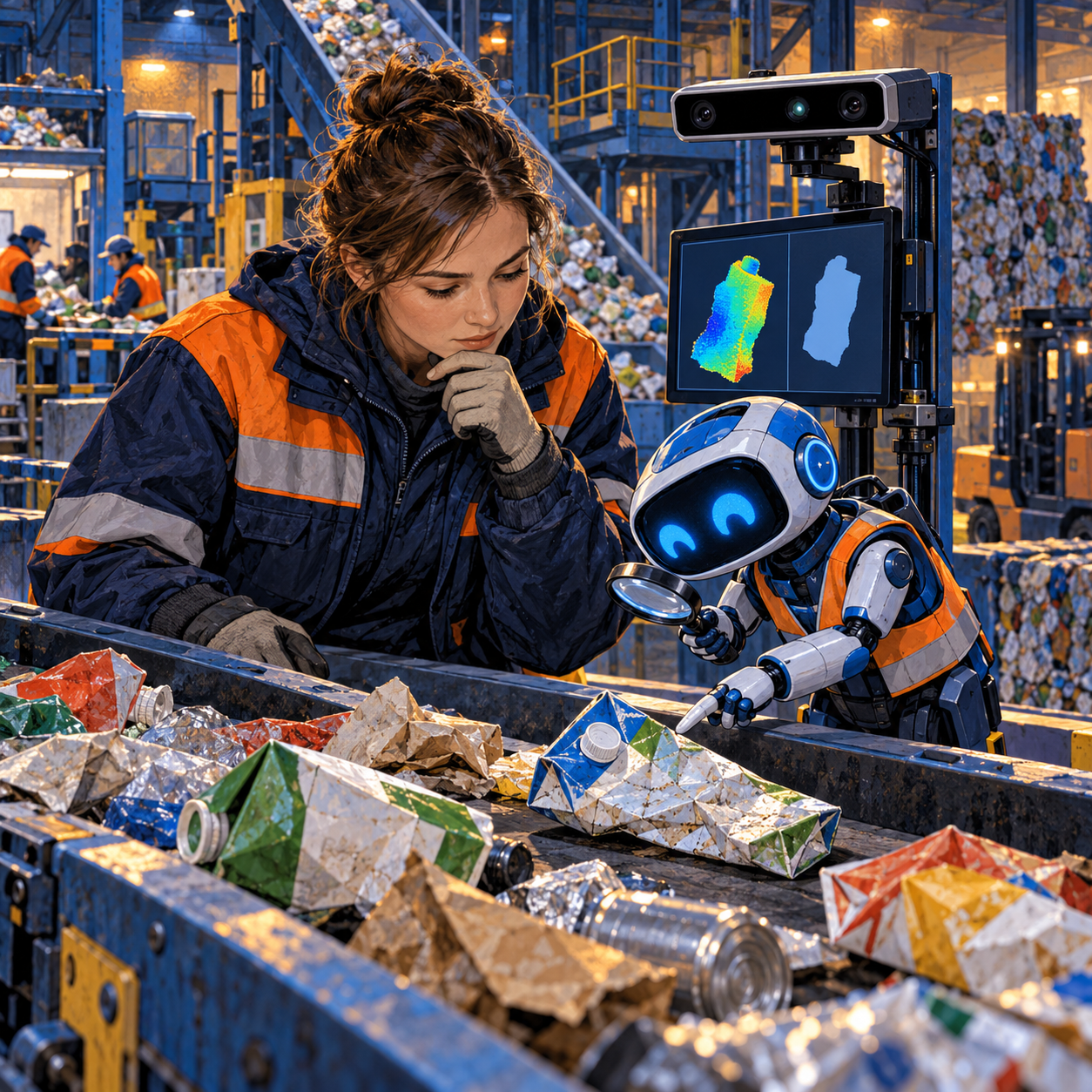
The business problem applies to any small production site handling irregular objects: removing repetitive manual work is attractive, but a failed robot action has a cost. A beverage carton may be crushed, folded and partly hidden under another item. A human can still understand its shape; a system configured around a neat catalogue picture may struggle. Our cover's tiny robot intern might inspect every crease with great enthusiasm. The conveyor will not wait for the research project to finish.
Why an ordinary camera is not enough
There are two separate tasks. First, the system must distinguish an item from the belt and adjacent waste, producing an object mask. Then it must find a place where a suction cup can make reliable contact. The centre of a rectangular detection box is not necessarily that place: it may land on a fold, a hole or a neighbouring package.
According to the European hub's account, the team compared segmentation methods, ways to detect flat surfaces and approaches to grasp-point selection using RGB imagery and RGB-D data, which also captures depth. The open methods tested included SuctionNet, KNN, Sobel and RANSAC. These are different tools, not four interchangeable off-the-shelf AI products: some use learned representations, while others draw on geometry and image processing. The appropriate combination depends on the objects and the quality of the images.
The evaluation used 98 RGB-D images from a real sorting facility. The hub also reports considerable variation in segmented point-cloud size: a mean of 16,265 points and a standard deviation of 8,411. That illustrates heterogeneous frames but says nothing by itself about the percentage of successful picks. The source does not report that metric. Image counts and point counts must not be turned into claims about line throughput.
A practical system boundary
For a pilot on an operating conveyor, we would split the system into five testable components. This is an editorial implementation outline based on the described evaluation, not a claim about Deltasort's actual installation.
- A camera with controlled lighting observes the pick zone. If depth materially improves point selection, add an RGB-D sensor and separately test its cost and tolerance of dust.
- Segmentation isolates an object and produces a confidence score. Uncertain frames go to a manual flow rather than nudging the robot towards an arbitrary move.
- A geometry module identifies a usable surface and suction-cup orientation. Rules exclude belt edges, overlaps and unreachable zones.
- The robot controller executes only validated commands. Vacuum contact, movement and release are checked by sensors, not inferred from an attractive on-screen mask.
- A log retains the frame, decision, outcome and error type. Without it, the team cannot tell whether to fix optics, the model, mechanics or the incoming waste stream.
A large language model is unnecessary on the time-critical picking path. Specialised computer vision and geometry running near the line are more suitable for low-latency decisions. An LLM could help later by summarising shift reports or finding recurring causes of failure in logs. It should not directly control manipulator motion based on a textual description of a frame.
Data and the limits of a pilot
The first asset is not a model but representative observations. The sample should include crushed cartons, different materials, overlapping objects, dirt, changing light and conveyor speed. A process specialist should help label what constitutes an object, which surfaces can actually be picked and which failures matter. Training and test images should be separated by shift or batch; near-identical adjacent frames can otherwise create a false impression of performance.
On a test rig, measure more than a single 'AI accuracy' number: object detection, first-attempt pick success, false picks, damage, misses, cycle time and manual interventions. Break down failures for the most awkward packages. For a small business, even a strong average can fail economically if the system often stops on a type of package that is rare in a demonstration but common in the real stream.
The NIST AI Risk Management Framework provides an independent measurement discipline: evaluate the system in the context in which it will operate, document limitations and avoid treating laboratory performance as proof of reliability after deployment. This is not a regulatory requirement for a Russian factory; it is a useful engineering habit.
Economics without a fabricated payback period
The hub's publication provides no capital cost, cycle-time figures, staffing before and after automation or cost of downtime. It therefore cannot support an honest ROI calculation for this case. Before ordering equipment, a manager can model the economics from their own figures: items per hour × share of successful automated picks × manual time saved, less the costs of sensors, robot, integration, maintenance, electricity and interruptions.
The downside scenario matters as much as the average one: a dirty lens, a new carton shape, a camera knocked out of alignment or an overloaded line. If an operator must still stand next to the conveyor throughout the shift, the saving in labour may be small. A pilot needs to settle this question before a capital budget is approved.
A useful first step is to collect a short shift-level sample from the existing line and, with a process specialist, list the five to seven most troublesome situations. Compare a simple baseline algorithm, RGB-D and the manual process on the same batches. Decide on a robot only after measuring pick success, cycle time and the cost of failure. The Deltasort case is valuable for precisely this sequence: prove that a system can see and grip real objects before promising automation.