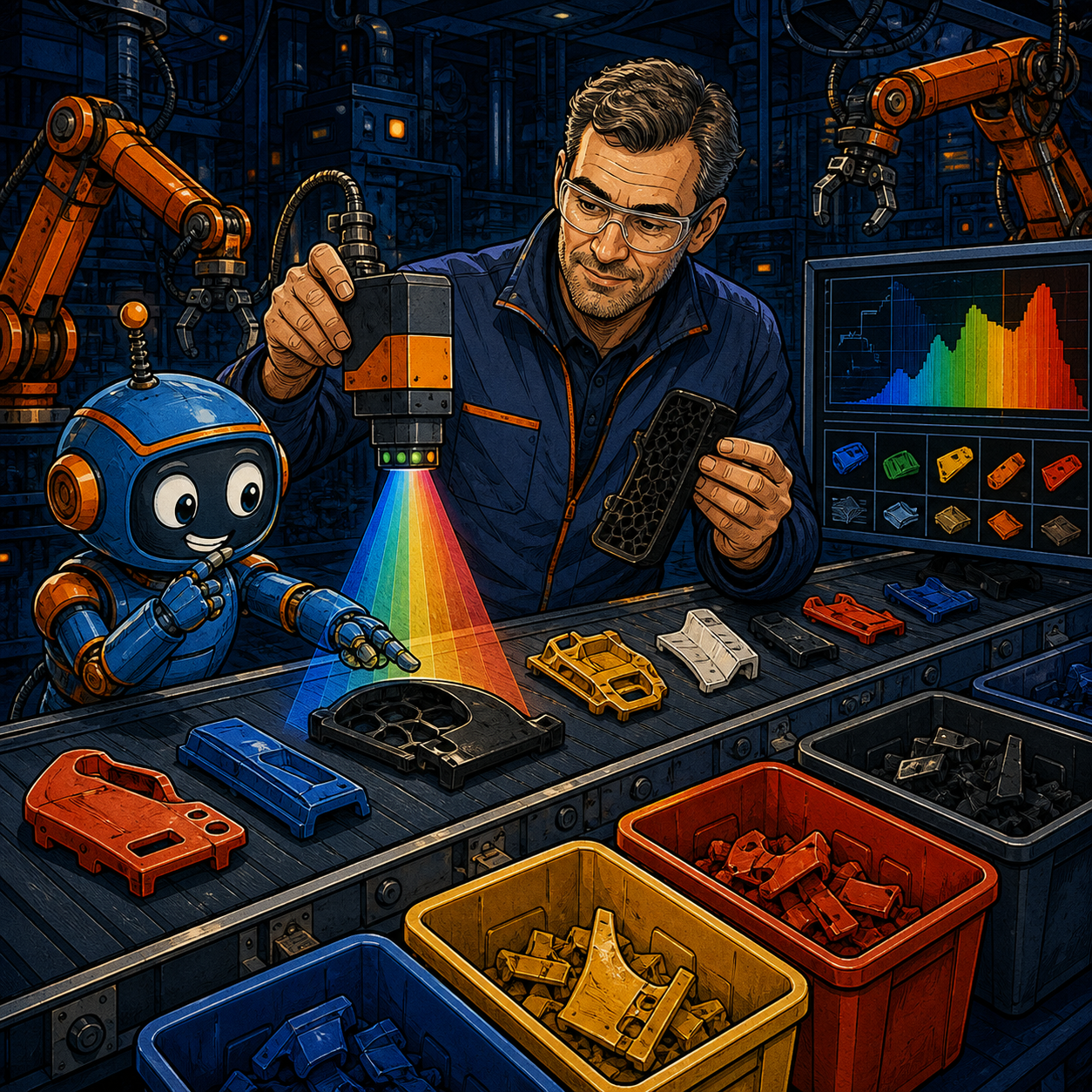
Case study: plastic cannot be identified by color alone
After a vehicle is dismantled, a recycler receives parts that look similar but differ in polymer and fillers. Mixing them reduces recyclate quality: equally black or grey fragments can behave differently during processing. Manual sorting is slow and depends on markings that may be dirty, damaged, or missing.
Spanish small company Canonical Robots developed CIRPLASTIC, a plastic-classification solution initially focused on the automotive industry. According to EIT Manufacturing, the system uses hyperspectral imaging and AI to recognize material signatures. The company transferred the approach from KIWISORT, where spectral analysis was used to assess kiwi fruit ripeness.
EIT reports that the prototype classifies PET, HDPE, PP, and three filled polypropylene grades at 98% precision and recall. This is a strong technical result, but not a finished factory ROI calculation. The publication does not disclose the test-set size, conveyor speed, share of black or contaminated parts, number of shifts, or cost of an error. The figure should therefore be read as the reported result on a material test matrix, not a promise of 98% on any production line.
How hyperspectral vision works
A conventional camera records a few broad color channels. A hyperspectral camera measures reflectance across many narrow wavelength bands. The result combines spatial shape with a spectral signature for each area. Polymers and fillers interact with light differently, allowing a model to classify material even when parts look alike to the eye.
A working line typically includes:
- a stable light source and shielded measurement zone;
- a hyperspectral camera above the conveyor;
- a position sensor or encoder linking spectra to individual parts;
- preprocessing such as dark and white reference correction, denoising, and normalization;
- a classification model and confidence threshold;
- a robot, air ejector, or other actuator;
- an "uncertain" bin for human inspection.
This is a reference pilot architecture, not a claim about every internal component of CIRPLASTIC; the public case does not disclose the complete hardware and algorithm stack.
Why transferring experience from food sorting makes sense
KIWISORT and plastic sorting solve different problems, but share an engineering frame. An item moves through a controlled zone, a sensor captures spatial-spectral data, a model assigns a class, and an actuator directs it to the appropriate route.
Reusable knowledge goes beyond model code. Experience with lighting, camera-conveyor synchronization, calibration, missing data, operator interfaces, and safe stops may be more valuable. For a small manufacturer, the lesson is to look for the first AI project near a process and dataset the team already understands rather than starting with an entirely unfamiliar line.
The fruit-ripeness model weights cannot simply be applied to polymers. The new task requires different references, wavelength choices, training data, acceptance criteria, and testing on actual feedstock.
What the public case confirms
The available materials support the following statements:
- Canonical Robots is a Spanish SME that developed CIRPLASTIC with EIT Manufacturing program support;
- the solution targets plastic classification, initially for automotive streams;
- six classes are reported: PET, HDPE, PP, and three filled PP grades;
- EIT cites 98% precision and recall for the reported test;
- the product is offered as Robot-as-a-Service to replace a large upfront purchase with an operating expense;
- operators retain roles in supervision, data checks, and maintenance.
The public production evidence does not establish throughput, uptime, cost per tonne, labor savings, payback, or stability across seasons and suppliers. A buyer must produce those measures in its own pilot.
The main technical risk: black and complex plastics
Independent reviews of sorting technology describe a physical limitation of near-infrared sensing: carbon black absorbs the incident light, leaving little reflected signal. Contamination, moisture, thin films, coatings, mixed materials, and additives such as flame retardants also create difficulties.
AI does not repeal this physics. If the sensor receives no discriminative signal, a more sophisticated neural network cannot invent it. Some feedstock may need another wavelength range, an additional sensor, markers, preprocessing, or a separate route.
Acceptance testing must therefore go beyond clean, brightly colored specimens. The proportion of black plastic and filled grades should match actual inbound material. Parts with oil, dust, scratches, labels, complex geometry, and surface aging need separate tests.
Data a recycler needs
The training set must represent a future shift on the line, not a product catalogue. Useful metadata for every specimen includes:
- laboratory-confirmed polymer and filler;
- supplier or batch, color, age, and surface condition;
- wavelength range, illumination settings, and calibration date;
- conveyor speed, location, and part orientation;
- contamination, moisture, and temperature;
- model decision, confidence, and physical destination;
- verification after sorting.
Randomly splitting adjacent image frames into training and test sets is dangerous because neighboring frames of one part are nearly identical. A stronger holdout uses separate batches, days, or suppliers. It measures transfer to new feedstock rather than recognition of a previously seen specimen.
Precision and recall must reflect business errors
Precision asks what proportion of pieces sent to the PP bin are actually PP. Recall asks what proportion of all PP pieces the system found. One average across six classes may conceal a weak class.
Production requires a confusion matrix. A foreign polymer contaminating a high-value stream may cost more than sending a valid piece through a second pass. Thresholds should therefore depend on the class and the downstream use of the recyclate.
A useful policy has three zones:
- high confidence: automatic sorting;
- borderline confidence: repeat measurement or human review;
- unknown spectrum: quarantine rather than forced assignment to the nearest class.
A new material or supplier should first run in shadow mode. The model predicts while the existing process controls the physical destination; results are compared before automation is enabled.
Safe integration with robotics
The model should not drive an actuator directly. A line controller receives a structured class, confidence, part ID, and measurement timestamp. Deterministic rules then verify the allowed class, threshold, conveyor position, and actuator readiness.
If the camera loses calibration, a response times out, or parts overlap, the item moves to manual review. Emergency stops, guarding, and the PLC remain independent of the model. People authorize threshold changes, new classes, and restarting the line after a fault.
The audit trail needs the model version, calibration, spectral-file identifier, decision, robot action, and downstream quality result. This separates model error from poor lighting, mechanical displacement, or an incorrect reference.
Modelled economics for a small line
Robot-as-a-Service shifts some capital expenditure into a recurring fee, but the public case does not provide CIRPLASTIC pricing. The buyer must still account for sensing and integration, feed preparation, maintenance, downtime, laboratory references, and manual review of uncertain parts.
Consider an illustrative line processing 600 tonnes per year. Cleaner sorting raises the value of 120 tonnes of a target fraction by RUB 4,000 per tonne, creating RUB 480,000 in benefit. Automation also saves 700 labor hours at RUB 700, adding RUB 490,000. The modelled gross annual benefit is RUB 970,000.
If service, maintenance, and quality control cost RUB 600,000 per year, the modelled net benefit is RUB 370,000. A RUB 550,000 pilot and integration would pay back in roughly 18 months. These are not Canonical Robots figures or a supplier quotation: every volume and rate is an assumption. The calculation fails if contamination improves the sales price less than expected or line downtime rises.
A pilot that avoids an expensive mistake
1. Over two weeks, collect representative parts from at least three batches and establish a laboratory reference.
2. Select two economically important classes plus a mandatory "unknown" category.
3. Test on a bench across color, contamination, orientation, and speed.
4. Record precision, recall, and the confusion matrix for each class separately.
5. Run in shadow mode and measure p95 latency, manual-bin rate, and drift across shifts.
6. Connect the actuator only after safety interlocks and repeat-measurement behavior are validated.
7. Calculate economics from verified fraction purity, downtime, and tonnes rather than laboratory accuracy.
CIRPLASTIC illustrates a sensible SME path: transfer a familiar sensing architecture into an adjacent industry, prove classification on a bounded matrix, and offer a service model. For a buyer, the next step is smaller than the marketing promise: its own dirty sample, an independent holdout, and a month of shadow operation before the first automated throw into a bin.