Why welding still relies on expensive trial and error
Norwegian SME 3D-Components develops RobTrack, a hardware-software platform for robotic welding and directed energy deposition. In these processes, an engineer must balance dozens of interdependent variables: power, speed, material feed, trajectory, geometry, cooling, alloy properties, and fixture conditions.
According to the FFplus case, a modern welding setup can expose more than 50 linked parameters. Testing combinations only through physical trials is slow. A qualification campaign may take weeks, consume premium alloys and machine capacity, and still fail to find the best operating window.
RobTrack already used AI-assisted process screening, but geometry analysis alone could not predict thermal and structural behavior accurately. The team needed physics-based welding models and parallel execution of many variants.
The SHAPE-AM workflow
The SHAPE-AM project connected four layers into one engineering process.
1. Experiment configuration
An engineer defines the material, geometry, pass sequence, heat-source parameters, and fixture. These inputs must be versioned. Without an exact link between a simulation, the physical part, and the executed process, the system quickly becomes an attractive gallery of disconnected contour plots.
2. Physics simulation
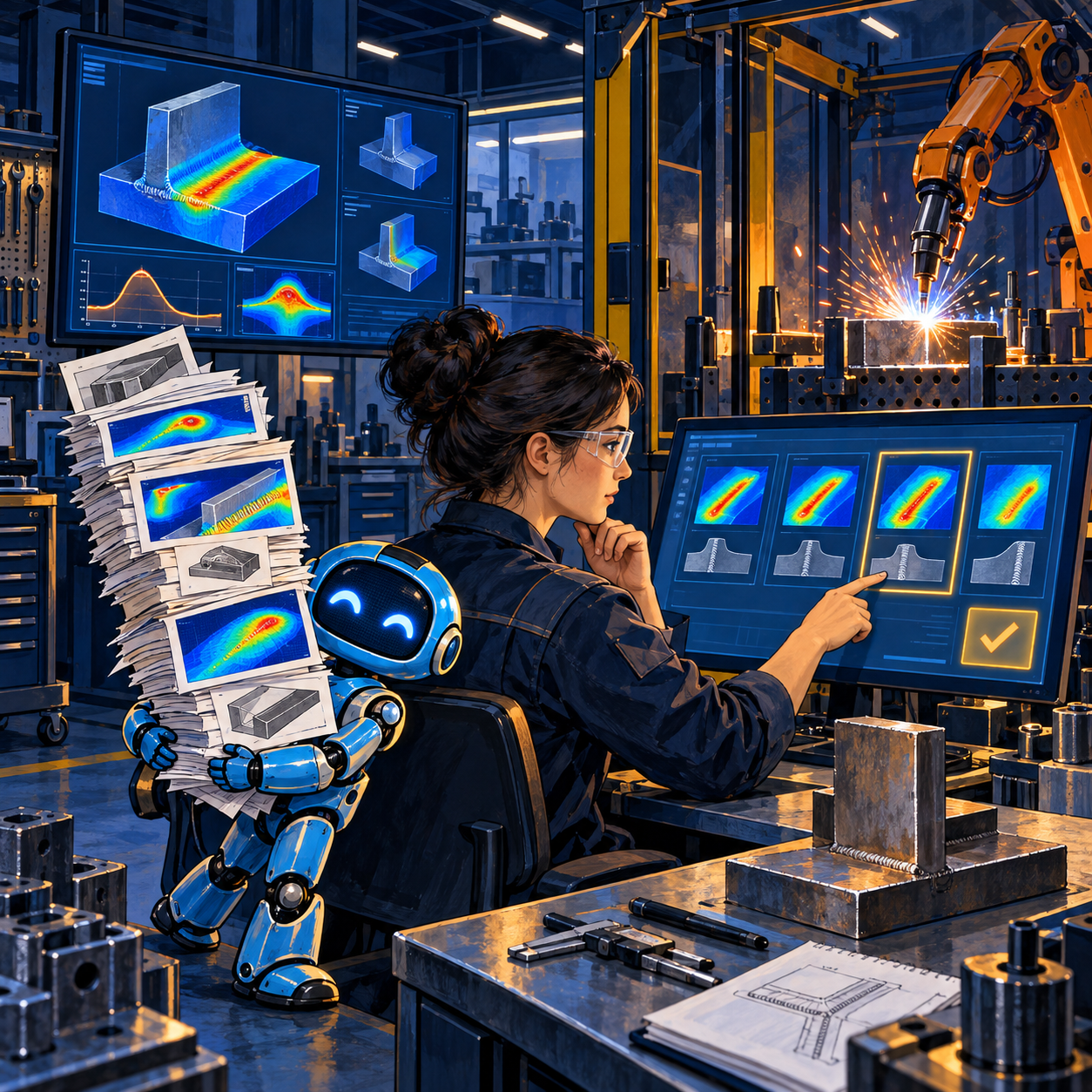
The configuration is converted automatically into a finite-element model in Simufact Welding. The solver estimates temperature fields, cooling rates, distortion, and residual stress. This is not an LLM producing an answer from text; it is a numerical solution of a physical model.
3. Parallel HPC execution
Variants ran on Norway's Saga cluster using up to 256 CPU cores per job. Parallelism matters not because every single simulation necessarily requires a supercomputer, but because engineers need dozens of variants within a decision window that fits a commercial project.
4. AI model and engineering decision
Simulation outputs become training data for models that predict process quality and structural performance. AI helps eliminate weak operating points and rank candidates. Final selection, physical testing, and procedure qualification remain engineering responsibilities.
Reported results
FFplus reports several measurable outcomes:
- a 40-variant study that took about 2.5 days on a workstation completed in roughly 1.5 hours;
- models predicted weld cooling rates with reported accuracy above 98%;
- process-development campaigns may be completed up to 200 times faster;
- material waste and associated emissions may fall by up to 90%;
- project estimates indicate operating-cost reductions of about 60%.
These figures should not be combined into one guaranteed saving. The 2.5-day versus 1.5-hour result applies to a particular workload and infrastructure. Accuracy above 98% refers to cooling-rate prediction, not universal defect-detection accuracy. “Up to 200 times” and “up to 90%” describe upper-bound benefits reported by the project participants.
Projected revenue growth and the estimated market of approximately 2,000 users are business forecasts, not confirmed sales results. A company evaluating the approach should replace them with local values: alloy cost, welding-cell time, engineering labor, and the observed rate of failed trials.
Simulation does not replace welding qualification
Virtual screening can reduce expensive physical experiments, but a prediction does not become a qualified production process. ISO 15614-1 specifies qualification of welding procedures through procedure tests and verification that joints achieve the required mechanical properties.
The practical role of the digital workflow is to narrow the search space. Instead of running dozens of loosely chosen trials, engineers receive a short list of justified candidates for physical validation. This is especially important when the alloy, thickness, fixture, or geometry changes. The model must demonstrate applicability rather than silently reuse an old operating window.
Required data and integrations
A reproducible pilot needs more than an archive of CAD files.
- material cards with temperature-dependent properties and documented provenance;
- part, weld, tooling, and fixture geometry;
- heat-source, feed, speed, and trajectory parameters;
- simulation results linked to solver and mesh versions;
- measurements from real samples, including thermal cycles, geometry, defects, and mechanical tests;
- a link between every simulated variant, physical run, and inspection outcome;
- a record of manual engineering corrections.
The integration layer normally includes experiment configuration, an HPC job queue, artifact storage, model versioning, and an interface for comparing candidates. An LLM may help produce reports or retrieve similar experiments, but it should not replace the physics solver or acceptance rules.
Defining the local boundary
A small manufacturer does not need to purchase a cluster. Sensitive CAD models, process sheets, and test results can remain on premises while sanitized simulation packages run on rented or sector-specific HPC. Another pattern keeps job preparation and validation local while executing the batch in a dedicated cloud environment.
Before transferring workloads, define:
- which fields are trade secrets;
- whether geometry can be separated from customer identity;
- where temporary files and backups are stored;
- who may launch expensive batches;
- how project data is deleted after completion.
A hybrid operating model is often practical: heavy physics simulations run in batches, while a compact ranking model executes close to RobTrack. When a case falls outside the training domain, the system should request a new simulation or manual review rather than guess.
Pilot economics
The useful comparison is not “the cost of AI,” but the cost of one process-development campaign before and after deployment.
The baseline should include:
- engineering hours;
- material and test pieces;
- machine time and setup;
- laboratory inspection;
- solver licensing;
- compute and storage;
- data and model operations.
An illustrative calculation, unrelated to the reported 3D-Components results: if a plant runs 12 campaigns per year and saves 30 engineering hours at RUB 2,500 plus RUB 50,000 in material per campaign, annual benefit is about RUB 1.5 million. A RUB 1 million pilot would pay back in roughly eight months, provided that the saving is verified and licensing or compute costs do not expand unexpectedly.
The primary metric is cost per qualified operating window, not the speed of one simulation. Fast computation has little value if it creates more repeat tests or engineers do not trust the recommendations.
A four-week next step
The first cycle can focus on one part family and 10–40 historical or deliberately selected operating points.
1. Record the baseline: physical trials, engineering hours, material, machine time, and campaign duration.
2. Select one predicted variable, such as cooling rate or distortion.
3. Calibrate the physics model using known samples.
4. Run variants in parallel and reserve a holdout set that the model has not seen.
5. Compare AI ranking with engineering judgment and physical tests.
6. Calculate the fully loaded cost of an accepted operating window, including licenses and compute.
Automatic recommendations should begin only after the system consistently removes weak candidates, reports its domain of applicability, and preserves a traceable decision record.
Business conclusion
The 3D-Components case demonstrates a useful industrial role for AI: not replacing the engineer or “generating a weld,” but connecting physics simulation, parallel computing, and fast parameter screening. The clearest reported result is the reduction of a 40-case workload from 2.5 days to 1.5 hours; broader economic claims require validation in each production environment.
For an SME, the sensible entry point is one expensive trial-and-error process, a clean experiment history, and explicit pilot economics. If the digital workflow reduces physical iterations without sacrificing quality, scaling becomes an engineering decision rather than a bet on a fashionable label.